The name does not identify the contest. Math League, the AMC, the Australian AMC and the American Mathematics Olympiad are published by four different organisations in three countries, and only one of them is Math League. Before your school orders anything, the question worth answering is not what the competition is called — it is who publishes it, who buys it, and where the results appear.
Four contests, three countries, one adjective
Every autumn, families in Chinese international schools are shown a list of maths competitions with names that sound closely related: the American Mathematics Competitions, the American Mathematics Olympiad, the Australian Mathematics Competition, and Math League. Two of those abbreviate to AMC. Three of them contain a nationality. All of them are legitimate competitions run by real organisations — and none of them is a version of another.
The confusion is structural rather than dishonest. Words like American, league, olympiad and challenge are descriptive; they are not accreditation. An adjective in a competition's name usually tells you something about its syllabus reference or its founding country, and nothing at all about who administers it, how hard it is, or whether the paper your child sits is the same paper sat elsewhere. When a name is translated into Chinese for a promotional post and the organiser is dropped from the line, the last identifying detail disappears with it.
- Contest registration
- Free past papers
- 1-on-1 trial lesson

This matters at two moments. It matters in September, when a school or an agency asks a family to commit money and a term of preparation to a specific contest. And it matters three years later, when the same student writes an award onto a university application and an admissions reader tries to work out what it was. Both moments are much easier if you settled the identity question at the start. If Math League itself is new to you, our overview of what Math League is sets out the structure before you compare anything to it.
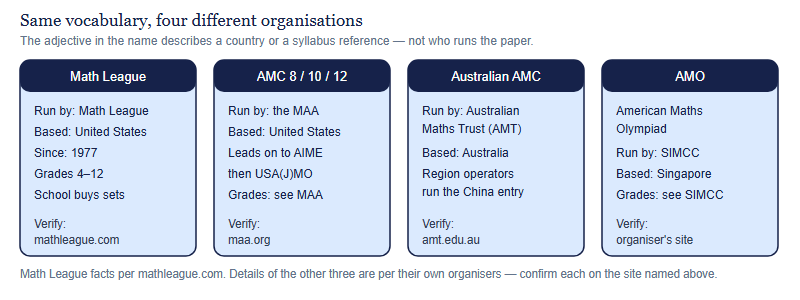
The identity table: who publishes what
The table below is deliberately thin on numbers. Grade ranges, question counts, fees and award tiers are set by each organiser and reissued year by year, so quoting them here would only give you a second-hand figure to be wrong about. What does not change from year to year is the publisher — and that is the field that identifies the contest.
| Name you were shown | Who publishes it | What the name actually tells you | Where to verify |
|---|---|---|---|
| Math League | Math League, United States, running since 1977 | A family of school contests across grades 4–12, sold to schools rather than to individuals | mathleague.com |
| AMC 8 / AMC 10 / AMC 12 | The Mathematical Association of America (MAA), United States | The entry rungs of a ladder that continues to AIME and then USA(J)MO, per the MAA | maa.org |
| Australian Mathematics Competition (also abbreviated AMC) | Australian Maths Trust (AMT), Australia | An Australian competition with its own China-region entry route operated locally | amt.edu.au |
| American Mathematics Olympiad (AMO) | SIMCC, based in Singapore, per the organiser's materials | Per the organiser's materials, "American" here refers to the syllabus reference rather than to the organiser's country | The organiser's own site |
That last row is the one that surprises people most often. A competition can carry a national adjective because its question style is written against that country's school syllabus, while being organised somewhere else entirely. Nothing improper is happening — but a parent who reads "American" and infers "this is the American one everyone talks about" has made an inference the name never supported.
If the contest in front of you turns out not to be Math League, our sister independent guides cover the others: the US AMC ladder at en.amcclub.org.cn, the Australian competition at en.australianamc.org.cn, and AMO at en.amoclub.org.cn. Each of those is an independent guide too, and each defers to its own organiser for dates and rules.
Four checks to run before your school orders
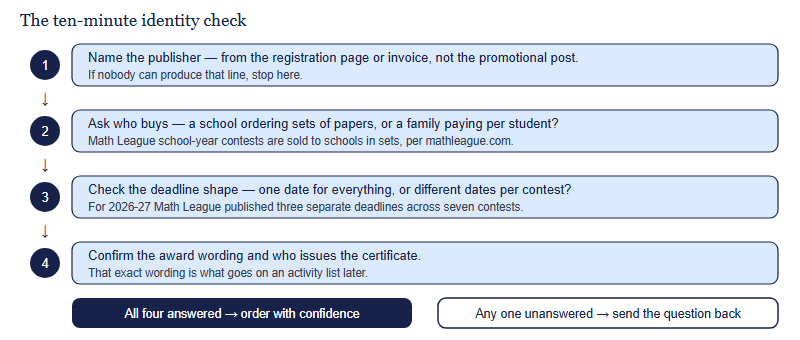
When a family forwards us a competition offer, these are the four things we look at, in this order. None of them requires expertise; all four can be done in about ten minutes.
Check 1 — read the publisher off the document, not the poster. Promotional material names the competition; the registration page, the invoice and the paper itself name the organisation. Ask for the line that says who publishes the contest. If that line cannot be produced, you do not yet know what you are buying.
Check 2 — ask who buys. This is the single most useful discriminator for Math League specifically, because its school-year contests are sold to schools as physical sets of papers rather than as individual entries. There is no per-student checkout and no student-facing sign-up form for those contests. If you are being invited to pay per student for a Math League school-year contest, that is not a scandal — it may be a regional operator's own arrangement — but it is a question worth asking out loud before money moves.
Check 3 — check the shape of the deadlines. Math League does not run one deadline for everything. Its published contest dates for the 2026-27 school year give the high school series a registration deadline of 30 September 2026, with the first of its six contests on 20 October 2026; grades 6, 7 and 8 register at the end of December 2026 and sit in February; grades 4, 5 and Algebra Course 1 register by 31 January 2027 and sit later still. Three deadlines, seven contest lines. A single all-contests deadline is therefore a signal that you are looking either at a different competition or at a regional operator's own internal window — both of which are fine, as long as you know which.
Check 4 — find out where results and award wording are published. Ask now what the certificate will say and who issues it. You will be copying that wording onto an activity list in a few years, and the time to discover that nobody can tell you the exact award name is before the season, not after it.
What Math League looks like when it really is Math League
It helps to know the silhouette of the thing you are trying to identify. Math League has run since 1977 for grades 4 to 12, and a few structural features recur consistently enough to be recognisable.
- Schools order, students sit. Contests are sold to schools as sets of papers with shipping included, priced per set rather than per entry. The person who has to act on a deadline is a teacher.
- The bands are not the same competition. Grades 4–5 and 6–8 sit a single 30-minute multiple-choice paper; grades 9–12 sit a season of six contests, six short-answer questions each, 30 minutes per contest, with no partial credit. Our grade-band guide settles which one applies before you compare anything.
- No calculators from September 2026. Math League has stated that from that point calculators are not permitted on any of its contests — a rule change worth checking against whatever a promotional page tells you.
- Asia is signposted separately. Math League points international enquiries towards a separate Asia-Pacific region website rather than its default US school pages, so a China-based family should not assume the US route describes their own. Confirm yours on mathleague.com.
- A published date per contest, not one global hour. For 2026-27 the six high school contests each carry a set date from October to March; grades 6, 7 and 8 are given a choice between two Tuesdays in February; and grades 4, 5 and Algebra Course 1 are listed as 15 April or later. Separate events, such as the online summer challenge, run to a fixed hour instead.
None of that is a test of legitimacy for other competitions — the AMC, the Australian competition and AMO each have perfectly coherent structures of their own. It is a recognition profile. If an offer described as Math League has none of these features, the useful next step is a question rather than an accusation: which contest and which route is this, exactly?
Why the label still matters three years later
There is a second reason to settle identity early, and it has nothing to do with money. An admissions reader assessing a maths award does not evaluate it in isolation. They read it against the transcript, against the rest of the activity list, and against how the student writes about their own work — and the award is persuasive to the degree that those sources corroborate each other. That is the cross-validation an application is built on.
An award that names its organiser precisely can be checked. An award described only as "American maths olympiad, gold" cannot, and a reader who cannot attribute a line usually does what any careful reader does with an unverifiable claim: they discount it. This is why a smaller, precisely named result is often worth more inside a file than a grand-sounding one nobody can place. It is also why the wording question belongs at the point of entry, when the organiser is on the screen in front of you, rather than in the last week before a deadline three years later. Once the identity is settled, the ordinary work begins — and our study roadmap is where that starts.
Nothing here decides an admission outcome, and no competition result does that on its own. What a correctly identified record does is make the rest of a file easier to believe.
Frequently asked questions
Is Math League the same as the AMC?
No. Math League has run since 1977 for grades 4–12; the AMC is published by the Mathematical Association of America. Different organisations.
Is the American Mathematics Olympiad run by Math League?
No. AMO is organised by SIMCC, based in Singapore, per its organiser's materials. Math League is a separate US organisation.
An agency mentioned "American Math League" — is that it?
The phrase alone identifies nothing. Ask for the publisher's name and the matching contest line on mathleague.com.
How do I confirm the route for a China-based student?
Math League signposts international enquiries to a separate Asia-Pacific site, so the US pages may not be your route. Confirm on mathleague.com.
This is an independent guide operated by Hanlin Education for China-based international-school students. It is not affiliated with, endorsed by, or sponsored by the official Math League (mathleague.com). Details of other competitions named here are per their own organisers. Grade ranges, formats, fees, registration routes and deadlines are set per edition and per region — confirm current details on mathleague.com. No competition result guarantees any admission outcome. Errors reported to us are corrected within 7 working days.