Starting Math League late is worth it in grade 10, usually worth it in grade 11, and a genuine judgement call in grade 12. The three year groups do not face the same competition. Grade 10 still has the full structure open to it, including the summer track; grades 11 and 12 have one product, the high school contest series; and a grade 12 season delivers most of its evidence after applications have already gone in.
The honest answer, by year group
Most articles about starting a competition late give one answer to three different questions. The useful answer depends on which year you are in, because what is available to you narrows sharply as you go up.
Grade 10. Start. Nothing is closed to you yet, you have two full seasons ahead, and the qualifying route into Math League's summer programme is still open — but only this year, which is the point most families miss.
- Contest registration
- Free past papers
- 1-on-1 trial lesson

Grade 11. Usually start, with clear eyes. You have a full season plus a partial one, and the record will be short but real. The summer track has closed behind you, so the six-contest series is the whole of what you are entering.
Grade 12. Only if you want the mathematics. The timing is against you for anything else, and pretending otherwise is how students end up spending autumn evenings on a record nobody will read in time. There are good reasons to sit it anyway; an application is not one of them.
What is actually open to a late starter
Math League runs several distinct things, and their grade ranges are not the same. The high school contest covers grades 9–12. The Algebra Course 1 contest is defined by the course a student is taking rather than by their year group. And the in-person International Summer Tournament, held at The College of New Jersey, was announced for grades 4 through 10 in its most recent edition — which puts a hard ceiling in the middle of this article's audience.
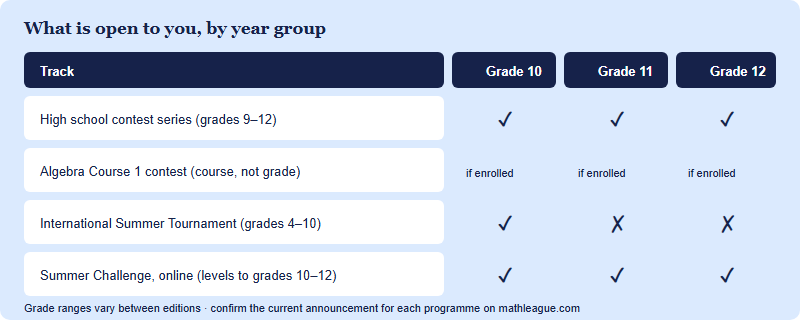
That ceiling gives grade 10 starters something the older years do not have: a reason for this season to lead somewhere. Math League's most recent tournament announcement lists a qualifying route for grades 9 and 10 through a cumulative score across the six high school contests, or through the Algebra 1 contest, and states that students may use scores from previous school years to qualify. It also notes that applications are considered from students who have not sat its contests but can demonstrate mathematical talent. Thresholds and grade ranges are set per edition, so confirm the current announcement on mathleague.com rather than planning around a number you read in a forum.
The timing problem nobody mentions
Two clocks work against a late starter, and neither is about mathematics.
The first is registration. Math League's contests are ordered by schools, and the high school series is ordered early because its materials ship at the start of the season rather than in spring. On the official school registration page we read at the end of August 2026, high school registration for 2026-27 closes on 30 September 2026, with tests shipping that October. Deadlines differ by registration route and region, so confirm your school's own date — but the shape of the problem holds everywhere: deciding in November that you would like to join this year's series is usually deciding to join next year's.
The second clock only affects grade 12. The high school contests are spread across the school year, and most undergraduate application deadlines fall between the autumn and January. A grade 12 student who starts in September will therefore have only the earliest contests of the season in hand when the file is submitted; the rest of the record arrives in spring, after the decision that mattered. This is not a reason to avoid the contests. It is a reason to be clear about what you are doing them for.
What one season can and cannot evidence
No competition result produces an admission decision, and anyone promising otherwise should be ignored. What a record can do is corroborate a claim the rest of a file is already making. The question for a late starter is what a short record is actually capable of corroborating.
| What admissions readers infer from | A one-season record | Why |
|---|---|---|
| Sustained commitment over years | Cannot evidence it | One season is one season; length is the whole signal here and you do not have it |
| Willingness to be measured externally | Evidences it well | You sat a timed contest against students outside your school, which most applicants never do |
| Genuine interest beyond the timetable | Evidences it, if it is not isolated | Credible when it sits alongside other mathematics you chose; thin when it is the only such item |
| Exceptional mathematical ability | Only if the results say so | A strong score speaks; participation does not, and dressing it up damages the rest of the file |
The practical consequence is that a late start is strongest when the honest framing is the one you use. A grade 11 student who sits a full season and improves has a real, modest, defensible item. A grade 12 student who sits two contests in October has an anecdote, and an anecdote presented as an achievement reads worse than nothing.
A six-week runway — and when to skip it entirely
Late starters consistently make the same mistake: they treat the gap as a content problem and start revising topics. It is almost never a content problem. A grade 11 student at a China international school has met most of the mathematics on a Math League paper; what they have not met is a 30-minute short-answer contest with no options, no partial credit and, from September 2026, no calculator. Six weeks is enough to fix the format gap. It is not enough to rebuild a syllabus, so do not try.
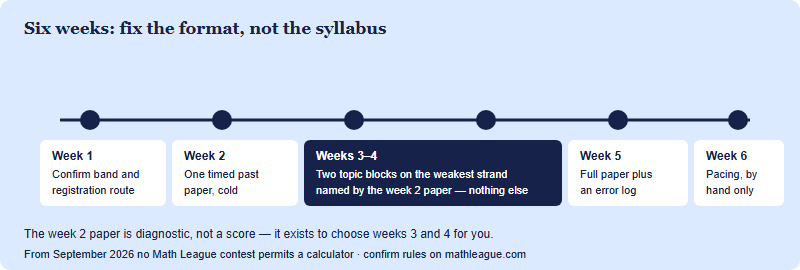
Two details make the difference between a runway and a fortnight of anxiety. First, sit the week 2 paper properly — timed, silent, no calculator, no restarts — and expect a low score. A first timed contest score is a measurement, not a verdict, and late starters who skip this step end up revising whatever they happen to dislike rather than whatever is actually costing marks. Second, keep weeks 3 and 4 narrow. Two strands, chosen by the diagnostic, done properly, beat six strands skimmed. Our study roadmap sets out how these blocks fit together across a longer runway if you have one.
There are three situations in which we tell students not to bother this year, and it is worth naming them plainly.
- Grade 12, autumn, applications not yet submitted. The competing demand is enormous and the payoff arrives after the deadline. If you love the mathematics, sit the contests anyway and enjoy them. If the motive is the application, spend the hours on the application.
- Your school has not registered and will not. The contests run through schools. Before building a plan, establish whether an entry route exists for you at all; a plan without a route is a wasted term.
- The band is wrong. A student placed above their level spends a season confirming that a paper is hard. Placement is the first decision, not an afterthought — our grade band guide covers students who sit between years.
Outside those three cases, a late start is a perfectly reasonable thing to do, provided the expectation is calibrated. What a late starter gets is not a credential. It is external measurement, a set of skills that transfer to every timed examination they will ever sit, and — for a grade 10 student — one remaining year in which the summer track is still on the table.
Frequently asked questions
Is grade 11 too late to start Math League?
No. The high school contest covers grades 9–12, so a full season is available. What has closed is the summer tournament, announced for grades 4–10.
Can a grade 12 student still enter?
Yes, the series covers grades 9–12. But most results arrive after application deadlines, so sit it for the mathematics, not the record.
How late can my school register?
High school registration for 2026-27 closes on 30 September 2026 on the page we read. Routes vary — confirm your own deadline on mathleague.com.
Should a late starter revise topics or practise papers?
Papers first. The gap is usually format — short answers, no partial credit, no calculator — and a diagnostic should pick the topics.
This is an independent guide operated by Hanlin Education for China-based international-school students. It is not affiliated with, endorsed by, or sponsored by the official Math League (mathleague.com). Grade ranges, qualifying thresholds, registration routes and deadlines are set per edition and per region — confirm current details on mathleague.com. No competition result guarantees any admission outcome. Errors reported to us are corrected within 7 working days.