The skill that separates competitors is not solving the questions you recognise — everyone does that. It is what you do in the ninety seconds after you read a question and think I have never seen this. There are five moves that reliably convert an unfamiliar question into a familiar one. Applied in order, they cost about a minute and a half.
Not recognising the question is the normal state
Students treat unfamiliarity as evidence of a gap in their preparation. Usually it is evidence that the paper is doing its job. A contest that only asked questions matching a known template would rank students by memory rather than by mathematics, so setters deliberately dress familiar structures in unfamiliar clothing. The mathematics you need is almost always mathematics you already have; what is missing is the translation.
That reframing matters practically, because the emotional response to "I don't recognise this" is what wastes the time, not the question. Students freeze, re-read the same sentence four times, and then abandon the question having produced nothing at all — no diagram, no small case, no bound. The recovery moves below exist to give your hands something to do while your recognition catches up.
- Contest registration
- Free past papers
- 1-on-1 trial lesson

One planning note before the methods. Whether an incorrect answer costs you anything relative to a blank depends on the marking scheme, and marking varies by contest and grade band — check yours on mathleague.com. If your contest does not penalise a wrong answer, a considered attempt is free, and recovery work is pure upside. If you are still orienting yourself, start with the overview of what Math League is.
The five moves
Each move takes a question you cannot start and produces something you can act on. They are ordered by how often they work, not by elegance.
| # | Move | Use it when | What it produces | Time |
|---|---|---|---|---|
| 1 | Shrink it Run the smallest cases |
The question involves a general number, a large number, or "how many ways" | A short table of results, often revealing the pattern or the answer itself | ~30s |
| 2 | Make it concrete Choose legal numbers |
The question is stated with letters, ratios, or "a number" with no value | An arithmetic problem you can definitely finish | ~20s |
| 3 | Read the answer's shape | You can tell what kind of thing the answer is before you can find it | Constraints: an integer, a count, a length, something under 100 | ~10s |
| 4 | Bound it Find the largest and smallest possible |
The question asks for a maximum, minimum, or "how many" with a limit | A narrow range — sometimes narrow enough to force one answer | ~30s |
| 5 | Hunt the unused fact | You have a method but it stalls, or your answer feels arbitrary | The condition you skipped, which is almost always the key | ~15s |
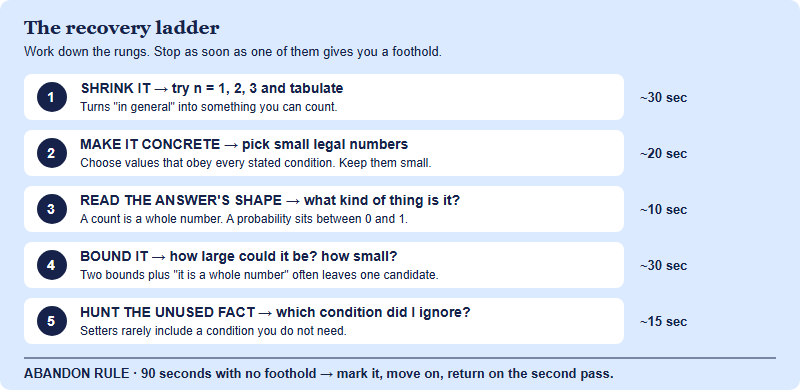
The ninety-second protocol
Moves without a time-box become the very trap they were meant to prevent. Use this sequence, and hold yourself to the clock.
- 0-15 seconds — re-read and mark up. Underline every stated condition and circle the exact quantity requested. Most recovery failures start as reading failures.
- 15-60 seconds — move 1 or move 2. Shrink it if the problem is about a general or large number; make it concrete if the problem is stated in letters or ratios. Write the small cases down; do not attempt them mentally.
- 60-90 seconds — move 3, 4 or 5. Constrain the answer, bound it, or find the condition you have not used yet.
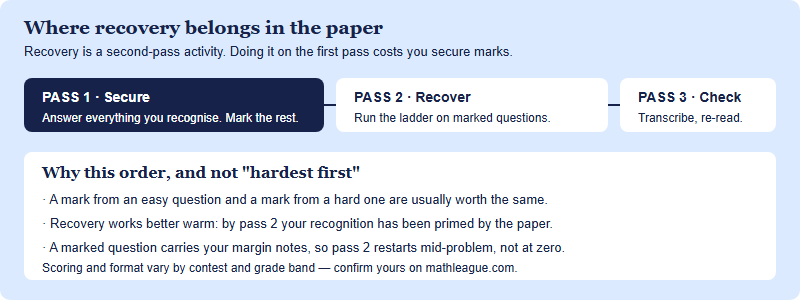
- At 90 seconds — decide. If you have a foothold, continue. If you have nothing, mark the question with a symbol you can spot from across the page and move on. Record whatever partial structure you found in the margin; on the second pass you will restart from there rather than from zero.
The abandon rule is the part students resist and the part that pays. Ninety seconds spent on a question you cannot start is ninety seconds not spent on two questions you can finish. Leaving is not surrender; it is scheduling.
What the moves look like in practice
The descriptions below are deliberately generic — they describe question shapes, not any specific past paper.
- Shrink it. A question asks how many regions are formed when a certain construction is repeated many times. You cannot picture the large case. So draw the case with one repetition, then two, then three, and count: 2, 4, 7. The gaps are 2 then 3, so each new repetition adds one more region than the last. You now have a rule, built in forty seconds from three drawings.
- Make it concrete. A question says one quantity is three-fifths of another and asks for a resulting ratio. Rather than carrying letters, set the second quantity to 5 — a value chosen so the fractions stay whole — and read the answer off directly. Choose numbers that satisfy every stated condition, and keep them small, because from September 2026 Math League has stated that calculators are not permitted on any of their contests, and ugly numbers are now paid for by hand.
- Read the answer's shape. If the question asks how many students, the answer is a non-negative whole number. If it asks for a probability, it lies between 0 and 1. This will not solve the question, but it invalidates wrong paths quickly and it tells you when a plausible-looking result must be wrong.
- Bound it. Asked for the largest value satisfying some conditions, establish that it cannot exceed one number and cannot fall below another. When a bounded range contains only one whole number that also satisfies a divisibility condition, the bounding is the solution.
- Hunt the unused fact. You have used the total and the ratio but not the word "different", or not the fact that the value is even. Setters do not include conditions for decoration. The unused one is usually what turns many possibilities into one.
How to train recovery on purpose
Recovery is trainable, but not by doing more problems of a type you already know. It needs drills that manufacture unfamiliarity, and it fits naturally into the practice cycle described in our study roadmap.
- The ninety-second drill. Take ten problems you have never seen. Spend exactly ninety seconds on each — no more — and write down only the foothold you found: a small-case table, a bound, the unused condition. Do not finish any of them. You are training the opening, and the opening is what fails in a real contest.
- Method bans. Solve a set with your default tool forbidden. If you always set up equations, ban algebra and force small cases. Fluency in a second route is what recovery actually consists of.
- Cold sets. Practise from mixed sets rather than topic-labelled ones. A topic label does half the recognition work for you, which is precisely the half the contest will not do.
- Log footholds, not answers. In review, record which move cracked each problem. After thirty problems you will see that one or two moves account for most of your recoveries — and that another one you never reach for would have worked repeatedly.
Three ways recovery goes wrong
The moves have failure modes, and knowing them is part of using them well.
- Sunk cost. Having invested two minutes, students stay because leaving feels wasteful. The two minutes are gone either way; the only live question is what the next minute is worth.
- Fake progress. Writing algebra that rearranges but never resolves feels productive and is not. Test: has the number of unknowns fallen? If not, you are decorating, not solving.
- Answering a different question. Recovery moves change the problem on purpose — you shrank it, or you substituted numbers. The danger is forgetting to change back. Before writing, re-read the final line of the question and confirm you are reporting the quantity actually asked for.
Used honestly, these five moves change what a hard paper feels like. The questions do not get easier. But the gap between "I have no idea" and "I have somewhere to start" narrows to about a minute — and that gap, across a whole paper, is worth more than any single technique you could memorise instead. Which paper you are training for matters too; if you are unsure, check the grade-band guide and confirm the current format on mathleague.com.
Frequently asked questions
Should I guess if recovery fails?
That depends on whether your contest penalises wrong answers. Marking varies by contest and grade band, so confirm the scheme on mathleague.com first.
Is ninety seconds not too short for a hard question?
It is the budget for finding a foothold, not for solving. Once you have a foothold you keep going; the clock only governs the blank phase.
Which move should I learn first?
Shrinking to small cases. It has the highest hit rate, needs no theory, and works across counting, sequences and geometry alike.
Do these moves still work without a calculator?
Yes, and they matter more. Math League has stated that from September 2026 calculators are not permitted, so substitute small, clean numbers.
This is an independent guide operated by Hanlin Education for China-based international-school students. We are not affiliated with, endorsed by, or sponsored by the official Math League (mathleague.com). Contest formats, marking schemes, rules and dates change from season to season — confirm current details on mathleague.com before you register or sit a paper. Errors reported to our editorial desk are corrected within 7 working days.