A Math League pattern question almost never asks for the next term. It asks for the 50th, the 100th, or the 2026th — a position deliberately too far away to reach by writing the list out. So the winning move is not to continue the sequence but to find a rule that maps position straight to value. Four question types cover most of what appears.
Why these questions are built to punish list-writing
Every pattern question contains a hidden fork. You can extend the sequence one term at a time, or you can find a rule and jump. The question setter chooses the term index precisely to make the first route lose. Asking for the 7th term rewards patience; asking for the 2026th rewards structure. When you see a large index, treat it as an instruction: stop listing, start indexing.
This matters more from the 2026-27 season onward. Math League has stated that from September 2026 calculators are no longer permitted on any of their contests — so the brute-force fallback of grinding out terms with a calculator is gone, and arithmetic you generate by hand is arithmetic you can get wrong. A rule you apply once beats forty operations you apply carefully. If you are still deciding which paper you sit, the grade-band guide is the place to start; formats differ by grade band and contest, so confirm yours on mathleague.com.
- Contest registration
- Free past papers
- 1-on-1 trial lesson

There is a second reason to care. Pattern questions are the most transferable topic on the paper. The indexing habit you build here is the same habit that cracks remainder questions in number theory and figure-growth questions in geometry. The same indexing habit often pays off on questions that were never labelled "sequence" at all.
The four question types
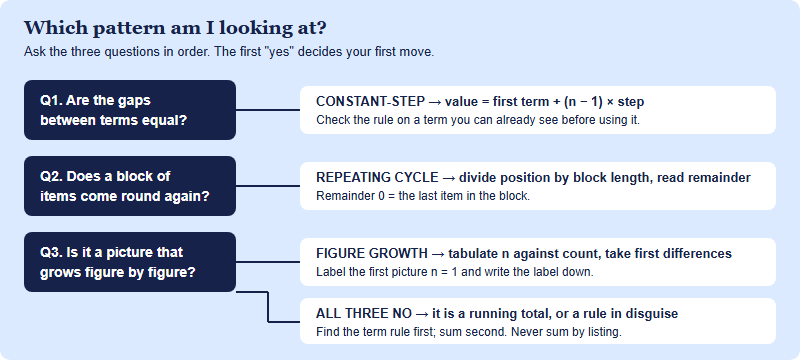
In our teaching, nearly every pattern question we see falls into one of four shapes. Identifying the shape is worth more than any formula, because each shape has a different first move — and using the wrong first move is how students lose three minutes before realising.
| Type | Giveaway phrasing | First move | The trap |
|---|---|---|---|
| 1. Constant-step (arithmetic growth) |
"increases by the same amount"; a list whose gaps are equal | Find the step d, then value = first term + (n − 1) × d | Multiplying by n instead of n − 1 |
| 2. Repeating cycle | "the pattern repeats"; letters, colours, days, units digits | Count the block length L, then divide the position by L and read the remainder | Remainder 0 means the last item of the block, not the first |
| 3. Figure growth (visual or dot patterns) |
A picture sequence; "how many squares in the 20th figure" | Tabulate figure number against count, then take first differences | Counting the picture you are shown as figure 0 |
| 4. Running total | "the sum of the first 30 terms"; "altogether" | Pair the ends, or find the term rule first and sum second | Answering with the final term instead of the total |
The position-first routine: three lines, every time
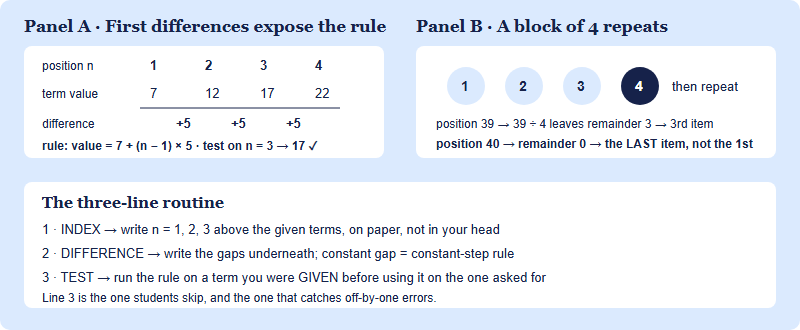
Strong students lose marks here not through weak algebra but through undisciplined set-up. The fix is a written routine that takes about twenty seconds and removes the two most common errors before they happen.
- Line 1 — index it. Write n = 1, 2, 3 above the terms you were given. Physically writing the index is what stops off-by-one errors; doing it in your head is what causes them.
- Line 2 — difference it. Write the gaps between consecutive terms underneath. Constant gaps mean a constant-step rule. Gaps that themselves grow by a constant amount mean the counts are growing quadratically — common in figure-growth questions.
- Line 3 — test it. Apply your candidate rule to a term you were given, not to the term you were asked for. If the rule reproduces term 3 correctly, it will survive term 300. This single check catches nearly every off-by-one.
The third line is the one students skip, and it is the one that pays. A rule that is wrong by one position produces an answer that looks entirely plausible — there is no internal warning, no impossible value, nothing to alert you. Testing against a known term is the only cheap way to detect it.
Cycles and remainders: the highest-return sub-skill
If you train one type properly, train cycles. They recur across topics — repeating decimals, units digits of powers, days of the week, positions in a repeating arrangement — and they are almost pure method, which means the return on practice is fast and reliable.
The method is always the same. Establish the block length L. Divide the position you want by L. The remainder tells you where in the block you land. The subtlety that costs marks is the boundary case: a remainder of 0 means you have landed on the last item of the block, not the first, because the block finished exactly. Students who learn this as a slogan rather than as a fact tend to get it backwards under time pressure, so verify it once on a small case you can count by hand — position 6 in a block of 3, say — and trust the verification rather than the memory.
The four traps that actually cost marks
In our editorial view, the four failures below cost more marks than genuine conceptual gaps do. None of them is a mathematics problem. All of them are set-up problems.
- Starting the index at 0. If you call the first given term n = 0, every later calculation is displaced by one step. Pick n = 1 and write it down.
- Trusting three terms. Three terms can fit several rules. If the sequence is short, find the rule and then confirm it reproduces all the given terms, not just the ones you used to build it.
- Answering the position instead of the value. Under time pressure students compute correctly, then write down the term number. Re-read the final line of the question before you write.
- Summing when the question wanted a term, or the reverse. "The 30th term" and "the sum of the first 30 terms" sit one word apart and are entirely different answers.
Notice that three of the four are caught by the same habit: read the last line of the question again immediately before writing your answer. That habit is worth more marks per second than any additional technique.
A two-week training block
Pattern questions respond quickly to focused practice because the method surface is small. Two weeks of short daily work usually moves this topic from a liability to a reliable source of marks, and it fits inside the wider sequencing described in our study roadmap.
- Days 1-3 — indexing. Take ten short sequences. For each, do only lines 1 and 2 of the routine: index and difference. Do not solve anything. You are building the reflex, not the answer.
- Days 4-6 — cycles. Twenty remainder questions, hand-computed. Deliberately include positions that are exact multiples of the block length so the remainder-0 case stops surprising you.
- Days 7-9 — figure growth. Tabulate before you theorise. Draw the next figure only if the table fails you.
- Days 10-12 — totals. Practise the pairing trick and, separately, deriving the term rule first. Time both; learn which is faster for you.
- Days 13-14 — mixed. Shuffle all four types. The examinable skill is identification, and identification cannot be practised inside a set where every question is the same type.
One note on band. In the lower bands we tend to spend more time on cycles and figure growth, where the arithmetic stays light, and from grades 6-8 upward more on constant-step rules and running totals with larger indices. If you are unsure what your paper is likely to contain, start from the overview of what Math League is and confirm the current format for your grade band on mathleague.com — the organisation has run contests for grades 4 to 12 since 1977, and the shape of the paper is not identical across them.
Frequently asked questions
Do I need the formal formula for arithmetic sequences?
No. Understanding "first term plus (n minus 1) steps" is enough, and it is harder to misremember under pressure than a symbolic formula.
What if the differences are not constant?
Take differences of the differences. If those are constant, the growth is quadratic — common in figure-growth questions where area increases.
How do I handle a remainder of zero?
Remainder 0 means the position lands on the last item of the repeating block, because the block has just finished exactly.
Are calculators allowed for these questions?
Math League has stated that from September 2026 calculators are not permitted on any of their contests. Confirm current rules on mathleague.com.
This is an independent guide operated by Hanlin Education for China-based international-school students. We are not affiliated with, endorsed by, or sponsored by the official Math League (mathleague.com). Contest formats, rules, dates and eligibility change from season to season — confirm current details on mathleague.com before you register or sit a paper. Errors reported to our editorial desk are corrected within 7 working days.