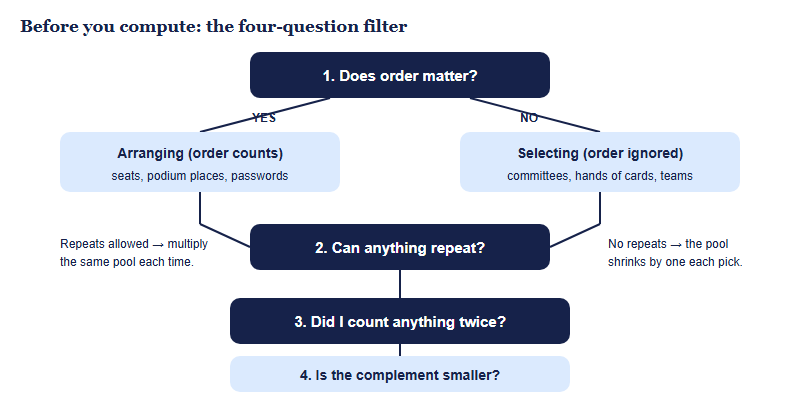
Counting problems feel harder than they are because most students attack them with a formula instead of a procedure. On Math League, almost every counting or probability question is settled by four questions asked before you compute anything: does order matter, can items repeat, have I counted anything twice, and is the opposite easier to count? Get those four right and the arithmetic is trivial.
The topic where the school curriculum leaves the biggest gap
In our teaching experience, counting produces a distinctive pattern: students who are strong in algebra and geometry are frequently weakest here, and it is not a talent gap. It is a coverage gap. Algebra and geometry get years of timetable across every syllabus a China-based international-school student is likely to follow. Combinatorics typically gets one short unit, often late, often taught as three formulas to memorise rather than as a way of thinking.
The result is a student who can recite the permutation formula and still cannot decide whether the problem in front of them is a permutation. That is the actual skill being tested. Formulas are the last five seconds of a counting problem; the decision is the first thirty.
- Contest registration
- Free past papers
- 1-on-1 trial lesson

There is also a scoring reason to take this seriously. Math League notes on mathleague.com that on each high school contest the last two questions are generally more difficult than the first four, and combinations and probability sit on its published list of high school topics alongside algebra, geometry, sequences and logarithms. Counting is a natural fit for the harder end of a paper because it lets a setter build a question that has no formula — only a decision procedure.
It is worth being clear about what “harder” means here, because it is not what students assume. A hard counting question rarely involves a bigger number or a more advanced formula. It involves one extra condition — the committee must include at least one girl, the digits must be distinct, the two red balls are identical — and that condition is precisely what breaks a memorised formula while leaving a decision procedure intact. If you are new to the contests themselves, our overview of Math League sets out how the papers are built before you start drilling topics.
The four questions, in order
Ask them in this sequence, in writing, every time. The written part matters: a decision made silently is a decision you cannot check when your answer looks wrong.
- Question 1 — does order matter? If ABC and CBA are different outcomes, order matters and you are arranging. If they are the same outcome, order does not matter and you are selecting. Test it on two concrete cases rather than reasoning abstractly: is first place Alex, second place Bo different from first place Bo, second place Alex? Yes — so order matters.
- Question 2 — can anything repeat? Drawing a digit for a code allows repeats; drawing a student for a committee usually does not. Repetition changes the model completely: with repeats you multiply the same count over and over, without repeats each choice shrinks the pool by one.
- Question 3 — have I counted anything twice? This is where nearly all wrong answers come from. If a rotation, a reflection, or a swap of two identical objects produces an arrangement you already counted, divide by the number of duplicates.
- Question 4 — is the complement smaller? Whenever a question contains the words at least, count the opposite instead and subtract from the total. At least one is almost always shorthand for total minus none.
The four models, side by side
Once questions 1 and 2 are answered, the model is fixed. The table below is worth copying into a notebook and reproducing from memory until the mapping is automatic.
| Order matters? | Repeats allowed? | Model | Typical wording | Worked shape |
|---|---|---|---|---|
| Yes | Yes | Multiply the pool k times | a 4-digit code from digits 0-9 | 10 × 10 × 10 × 10 = 10 000 |
| Yes | No | Shrinking product (permutation) | first, second and third from 8 runners | 8 × 7 × 6 = 336 |
| No | No | Permutation divided by the arrangements of the chosen (combination) | a committee of 3 from 8 people | (8 × 7 × 6) ÷ (3 × 2 × 1) = 56 |
| No | Yes | Grouping identical items; usually solved by careful casework at contest level | 3 scoops of ice cream from 5 flavours, repeats allowed | List by case: all same, two same, all different |
Notice that the third row is simply the second row with the double counting removed. That is the entire relationship between permutations and combinations, and a student who understands it in that form never has to remember which formula is which — they can rebuild it in ten seconds under exam pressure.
The fourth row deserves a warning. Selections with repetition have a standard formula, but at contest level the reliable route is organised casework, because the questions almost always attach a side condition that the formula does not handle. A student who lists cases systematically — all three the same, exactly two the same, all different — will beat a student reaching for a half-remembered formula, and will still be right when the question adds “and no flavour may be chosen more than twice”.
A related habit worth building early: when a problem is small, just list. If the total is under about twenty outcomes, a systematic list is faster and safer than any formula, and it doubles as a check on your reasoning. Students often feel that listing is unsophisticated; on a timed paper it is simply efficient, and it builds the same instinct that the high school series later tests formally through combinations and probability.
Complementary counting: the single highest-return habit
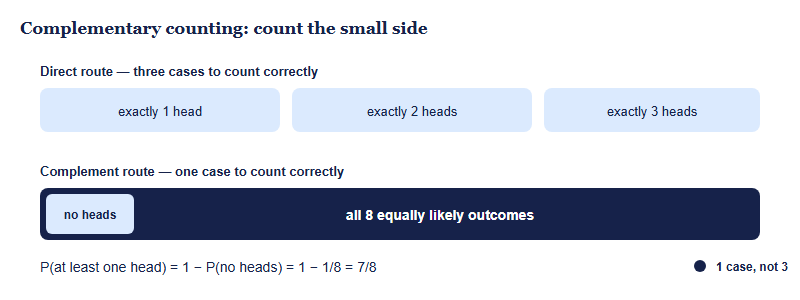
If a student only changes one thing after reading this article, it should be this. Whenever a question asks for at least one, at least two, or not all the same, stop and check whether the opposite case is smaller.
The classic shape: three coins are tossed; what is the probability of at least one head? Counting directly means handling one head, two heads and three heads — three cases. Counting the complement means handling no heads — one case, one outcome out of eight, giving 1 − 1/8 = 7/8. The saving is not just time; it is the elimination of three separate opportunities to miscount.
The same habit applies to non-probability counting. How many three-digit numbers contain at least one 7? is painful directly and easy as all three-digit numbers minus those containing no 7 at all.
Probability wording: three patterns worth recognising instantly
Contest probability is mostly counting wearing a different hat: probability equals favourable outcomes divided by total outcomes, provided the outcomes are equally likely. That proviso is where questions are won and lost.
- “At least” → complement. Covered above, and it is one of the most reliable trigger phrases to watch for.
- “And” versus “or” → multiply versus add, but only under conditions. Multiply probabilities when events are independent; add counts only when the cases cannot overlap. If they can overlap, add and then subtract the overlap once.
- “Without replacement” → the denominator changes on the second draw. Two marbles drawn from a bag of ten means 10 then 9, not 10 then 10. Students who mis-handle this are usually the ones who never wrote down the answer to question 2 of the filter.
One more discipline: check that your final probability is between 0 and 1, and that a fraction you produce could plausibly come from the denominator in the problem. A probability of 7/12 in a problem whose total outcomes are a power of two is a signal to go back, not a signal to move on. On papers marked strictly against a solution key, that ten-second sanity check is free insurance.
A three-week counting block
Counting rewards short, dense practice more than long sessions, because the gain is in decision speed. If you are fitting this into a broader plan, see the study roadmap for how topic blocks sit alongside timed practice.
- Week 1 — classification only. Take thirty counting questions and, for each, write only the answers to the four filter questions and the model you would use. Do not compute. Ten minutes a day is enough, and the ratio of correct classifications tells you exactly where you stand.
- Week 2 — overcounting drills. Work only on problems involving identical objects, circular arrangements and unordered pairs. This is the single most common source of near-miss answers, and it is trainable in isolation.
- Week 3 — complement and mixed timing. Do full mixed sets under contest conditions, and mark each error as wrong model, double counted, or arithmetic. Those three categories need three different fixes and should never be lumped together as “careless”.
For students entering the middle grades, this block pairs naturally with the topics covered in the grade-band guide. Math League has run contests since 1977 across grades 4 to 12, and combinations and probability sit on its published high school topic list, while the same systematic-listing instinct is worth building well before that. The habit of writing down the decision before the formula is the part that transfers all the way through.
Frequently asked questions
How do I tell a permutation from a combination quickly?
Test two concrete outcomes. If swapping two chosen items gives a different result, order matters and it is a permutation; if not, it is a combination.
Why do I keep getting counting answers slightly too large?
Almost always double counting. Check whether identical objects, rotations or unordered pairs mean each arrangement was counted more than once.
Is probability on the Math League high school contests?
Yes. Math League lists combinations, probability and coordinate geometry among topics its high school problems draw from. Confirm current details on mathleague.com.
Does the no-calculator rule make counting harder?
Not really. Counting answers are usually small whole numbers or simple fractions, so it is one of the least calculator-dependent topics on the paper.
This is an independent guide operated by Hanlin Education for China-based international-school students. We are not affiliated with, endorsed by, or sponsored by the official Math League (mathleague.com). Contest dates, eligibility, formats and rules change — always confirm current details on mathleague.com before entering. Any factual error reported to our editorial desk is corrected within 7 working days.