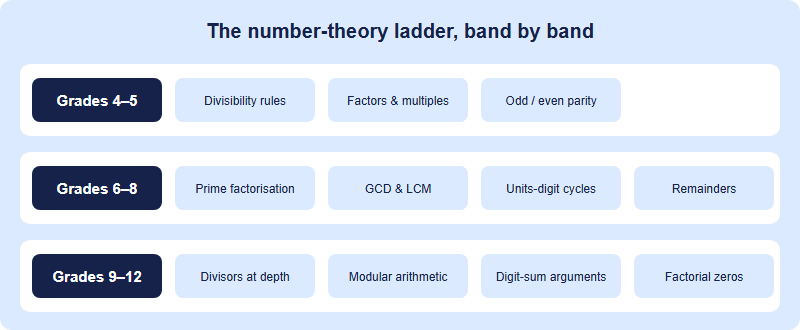
Number theory is the highest-return topic to train for Math League, because it runs across every grade band, it never depended on a calculator, and almost all of it reduces to six reusable tools: divisibility rules, prime factorisation, GCD and LCM, units-digit cycles, remainders, and divisor counting. Learn those six properly and a whole family of questions becomes routine.
Why this topic matters more from September 2026
Math League states on mathleague.com that from September 2026 calculators are no longer permitted on any of its contests. That change hits different topics unevenly. Long multi-step arithmetic gets harder. Number theory barely notices — because a calculator was never much help on “what is the remainder when a huge power is divided by 7”, and it was actively useless on “how many positive divisors does 7200 have”.
There is also a curriculum reason this topic feels harder than it is. Most school syllabuses in China and in international programmes touch divisibility and factors briefly in one early unit, then move on to algebra and geometry, which get years of attention. Number theory is therefore the one contest topic where a strong school student may genuinely never have been taught the standard tools — not because they are difficult, but because nothing in the timetable required them. Students routinely describe these questions as “tricky” when the honest description is “unmet”.
- Contest registration
- Free past papers
- 1-on-1 trial lesson

The practical consequence for a China-based student planning the season is that number theory now has an unusually good ratio of marks gained to hours spent. It is also one of the few areas where a grade-7 student and a grade-11 student use the same core tools, just at different depths. If you are still deciding which contest to enter, start with our overview of Math League and the grade-band guide — Math League has run contests since 1977 and covers grades 4 to 12, and the tools below appear at every level in different clothing.
The six tools, and where each one enters
Students who “cannot do number theory” almost always have gaps in the ladder rather than a general weakness. The order below matters: divisor counting is impossible until prime factorisation is automatic, and remainder work is unstable until divisibility rules are instant.
| Tool | The question it answers | What must be automatic |
|---|---|---|
| Divisibility rules | Is this number a multiple of 3, 4, 8, 9 or 11? | Digit sum for 3 and 9; last two digits for 4; last three for 8; alternating digit sum for 11. |
| Prime factorisation | What is this number really made of? | Splitting any number under 1000 into primes in under fifteen seconds. |
| GCD & LCM | When do two cycles line up? What is the shared part? | GCD × LCM = product of the two numbers. |
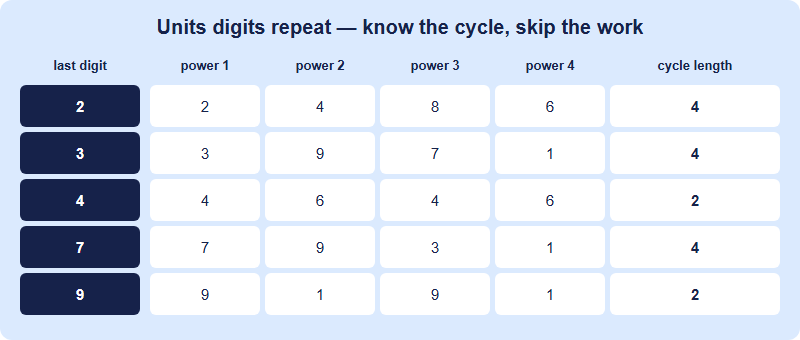
| Units-digit cycles | What is the last digit of a large power? | The cycle lengths of 2, 3, 7 and 8 (four) versus 4 and 9 (two). |
| Remainders | What is left over, and what satisfies two conditions at once? | Writing “N = 9k + 4” and substituting into the second condition. |
| Divisor counting | How many factors does this number have? | Add one to each exponent, then multiply. |
Read the right-hand column of that table again, because it is the whole training plan. Every entry is a speed requirement, not a comprehension requirement. Understanding why adding one to each exponent counts divisors takes about five minutes; being able to factorise 1176 while a clock runs takes about three weeks of short daily contact. Students who study this topic by reading explanations and then fail on paper have almost always mistaken the five-minute part for the three-week part.
Units-digit cycles: the table worth memorising
Last-digit questions look intimidating and are mechanical. Only the last digit of the base matters, and last digits repeat in short cycles. Memorise the cycle lengths, and any exponent question collapses to a division with remainder.
Six worked archetypes
These are our own illustrative problems, written to mirror the shapes that recur — not reproductions of any contest paper. Work each one before reading the solution.
1. Divisor counting. How many positive divisors does 7200 have?
Factorise: 7200 = 25 × 32 × 52. Add one to each exponent and multiply: 6 × 3 × 3 = 54. The whole question is one factorisation plus one multiplication — under thirty seconds once factorising is automatic.
2. Last digit of a large power. What is the units digit of 72026?
The cycle for 7 is 7, 9, 3, 1, length 4. Divide the exponent by the cycle length: 2026 = 4 × 506 + 2, so we want the second entry. Answer: 9. Note the standard slip — a remainder of 0 means the last entry of the cycle, not the first.
3. Two remainder conditions at once. Find the smallest positive integer that leaves remainder 3 when divided by 7 and remainder 4 when divided by 9.
Write the harder condition as a form: N = 9k + 4. Substitute into the other: 9k + 4 leaves remainder 3 on division by 7, so 2k + 4 leaves remainder 3, so 2k leaves remainder 6, so k leaves remainder 3 on division by 7. Smallest k = 3, giving N = 31. Check both: 31 = 7 × 4 + 3 and 31 = 9 × 3 + 4.
4. GCD and LCM together. Two positive integers have GCD 6 and LCM 180. One of them is 30. What is the other?
Use GCD × LCM = product of the numbers: 6 × 180 = 30 × b, so b = 36. Verify: GCD(30, 36) = 6 and LCM(30, 36) = 180.
5. A missing digit. In the four-digit number 43_1, what digit makes it a multiple of 9?
Digit sum must be a multiple of 9: 4 + 3 + d + 1 = 8 + d, so d = 1. Digit-sum rules turn a search into one line of arithmetic.
6. Trailing zeros of a factorial. How many zeros does 100! end in?
Zeros come from factors of 10 = 2 × 5, and fives are scarcer. Count multiples of 5 up to 100 (20 of them), then multiples of 25 which contribute a second five (4 of them): 20 + 4 = 24. Students who count only the first round and answer 20 are making the single most common error in this archetype.
A seventh shape worth rehearsing is inclusion–exclusion counting: how many integers from 1 to 200 are divisible by 3 or by 5? Count 66 multiples of 3, 40 multiples of 5, subtract the 13 multiples of 15 counted twice: 93.
An eighth, which appears in harder papers, runs the divisor rule backwards: what is the smallest positive integer with exactly 12 divisors? Since 12 = 4 × 3 = 2 × 2 × 3 = 6 × 2, the candidate exponent patterns give 23 × 32 = 72, 22 × 3 × 5 = 60 and 25 × 3 = 96. The smallest is 60. The general principle is worth internalising: put the larger exponents on the smaller primes, and always test more than one pattern before answering.
The traps that cost marks
- Divisors versus prime factors. 7200 has 54 divisors but only three distinct prime factors. Read which one is asked.
- 1 is not prime. It is also a divisor of everything, so it must be counted in divisor totals and excluded from prime lists.
- Perfect squares behave differently. Only perfect squares have an odd number of divisors, because one factor pairs with itself. Questions asking for “an odd number of factors” are square questions in disguise.
- Cycle position off by one. When the exponent divides exactly by the cycle length, take the last element, not the first.
- “Between” is ambiguous in English. Decide immediately whether the endpoints are included, and write the decision down. Our study roadmap treats this phrasing risk as a vocabulary problem, not a maths problem — because that is what it is.
- Digits versus numbers. “How many digits” and “how many numbers” are different questions and both appear.
Notice how many of those traps are linguistic rather than mathematical: divisors against prime factors, digits against numbers, between against from … to. For a student working in their second language under a clock, this is the difference between a correct method scoring and a correct method scoring nothing. The cheap habit that fixes most of it is to underline the noun that is being counted before writing a single line of working.
A four-week training block
Number theory rewards short daily contact more than long weekend sessions, because most of it is recall speed rather than insight.
| Week | Daily 15 minutes | Weekly session (45 minutes) | You can stop when |
|---|---|---|---|
| 1 | Factorise ten numbers under 1000 from memory. | Divisibility rules for 3, 4, 8, 9, 11 with mixed drills. | Any three-digit number factorises in under 15 seconds. |
| 2 | Ten divisor-count questions. | GCD and LCM word problems; the product identity. | You never confuse divisor count with prime count. |
| 3 | Ten units-digit questions. | Remainder systems written as N = mk + r. | Cycle position errors drop to zero. |
| 4 | Mixed set of ten, untyped. | Full timed section, then log errors by cause. | Mixed sets score as well as single-topic sets. |
The final row is the real test. Students routinely score well on a page labelled “remainders” and badly on the same question hidden inside a mixed paper, because half the skill is recognising which tool a question wants. Once mixed sets match single-topic sets, the topic is genuinely trained.
Frequently asked questions
Do I need modular arithmetic notation to do these questions?
No. The “N = 9k + 4” substitution method handles nearly everything. Formal notation is convenience, not a requirement.
Which grade band should start divisor counting?
Once prime factorisation is automatic, usually in the middle-school band. Without that foundation the rule becomes memorised and fragile.
Does the September 2026 no-calculator rule change number theory questions?
It changes preparation, not the topic. Mental arithmetic speed now matters more. Confirm current rules on mathleague.com.
How much of a Math League paper is number theory?
It varies by contest and year, so we do not publish a percentage. Confirm the format for your own band on mathleague.com.
This is an independent guide operated by Hanlin Education for China-based international-school students. We are not affiliated with, endorsed by, or sponsored by the official Math League (mathleague.com). All practice problems above are our own illustrations, not contest questions. Contest formats, rules and dates are set by the organiser and can change — confirm current details on mathleague.com. Errors reported to us are corrected within 7 working days.