Short answer: after you submit the 2026-27 Math League Online Preliminary, do not share or disclose any test question, in any form, until the organizing committee announces the preliminary round results. The official Notes for Participants states two things plainly — sharing or disclosing test questions is “strictly prohibited” before results are announced, and a student who leaks test questions will have their score cancelled. The consequence is score cancellation, not a warning.
Scope note: these rules come from the Math League 2026-2027 participant notes for the online preliminary round (published by Math League, retrieved October 2026). US/Canada school contests run under a different registration system and their own contest procedures; this article covers the online preliminary participant notes.
This article answers one question that families ask the moment the exam ends: can we talk about it now? The rest of the piece explains the disclosure window, what “in any form” actually covers, why group chats are the highest-risk channel, and the difference between the ban on disclosure and the legitimate review that opens once results are published.
- Contest registration
- Free past papers
- 1-on-1 trial lesson

When does the ban end? The trigger is the results announcement
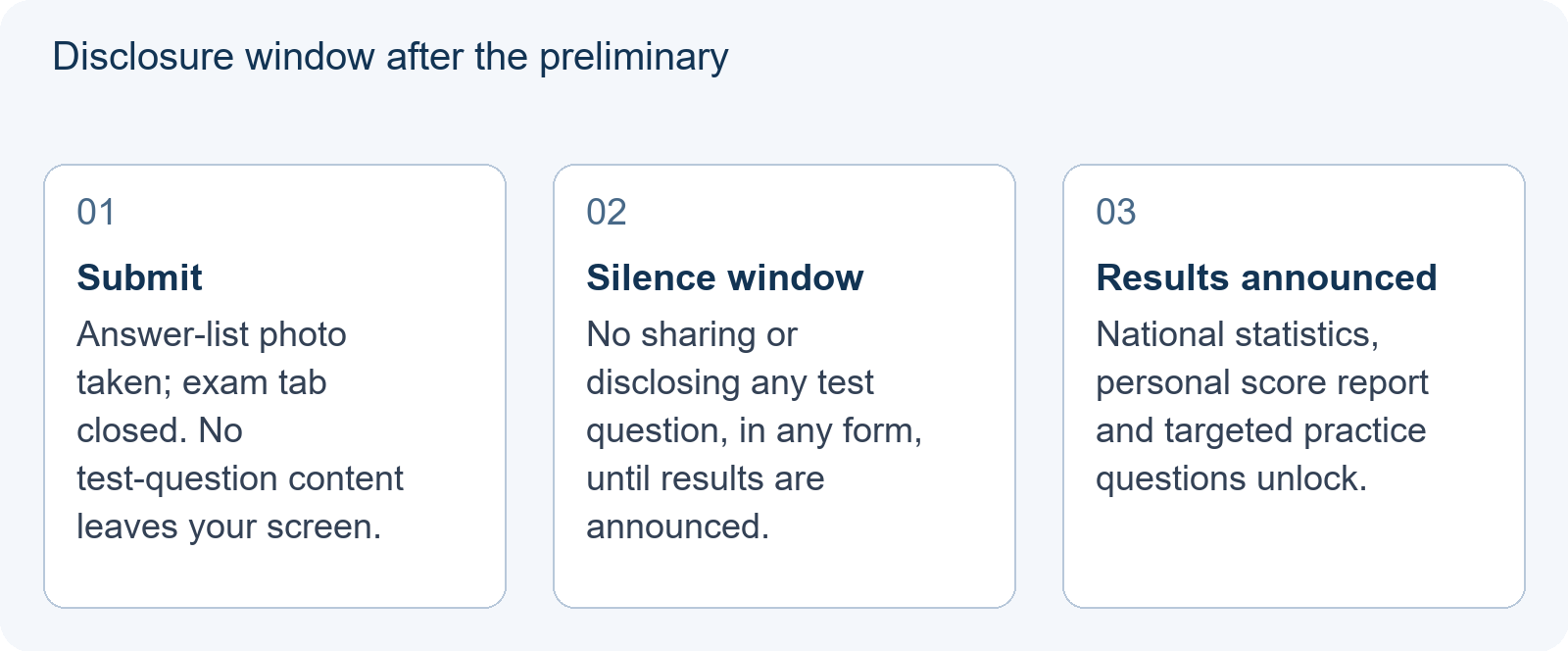
The prohibition is a time window, not a permanent rule. It runs from the start of the preliminary until the organizing committee announces results. Once results are out, the participant notes describe what students can then access on the official website — national statistics, a personal score report and targeted practice questions.
What this means in practice: submitting your answers does not end the obligation. Signing out of the exam system does not end it. Telling yourself that your attempt is finished does not end it. The trigger is the official announcement, which is a separate event with its own timing, not something you can infer from the moment the timer hits zero.
For a season-level view of the 2026-27 preliminary — what changed this year and how the semi-final qualification gate works — see our guide to the Math League Preliminary Round 2026-27 (12 December): What Changed From Last Season for China Students, and the Top-50% Semi-Final Gate. That article covers the pathway; this article stays on the disclosure rule.
What counts as “sharing or disclosing” a test question
The notes say “in any form,” and that phrase is deliberately broad. The table below sets out what falls inside the ban before results, and where the boundary cases sit.
| Behaviour | Inside the ban before results? | Why |
|---|---|---|
| Posting a screenshot of the exam screen | Yes | Direct disclosure of a question |
| Typing a recalled question into a group chat | Yes | Disclosure by reconstruction (“in any form”) |
| Describing a question verbally to a classmate | Yes | Disclosure in spoken form |
| Sharing a partial hint (for example, “Q18 used a remainder pattern”) | Yes | Still reveals a specific item to a reader |
| Reporting your own estimated total score, no question content | Outside the ban | Not a test question; no item is disclosed |
| General talk about timing or difficulty, no identifiable item | Boundary case | Safe only while no question can be identified from what you say |
The first four categories are what the notes target. The last two are the boundary cases families most often get wrong, because “what topics were on it?” feels like a harmless icebreaker. The operative test is simple: if a friend can identify a specific question from what you sent or said, you have disclosed that question.
Why group chats are the highest-risk channel
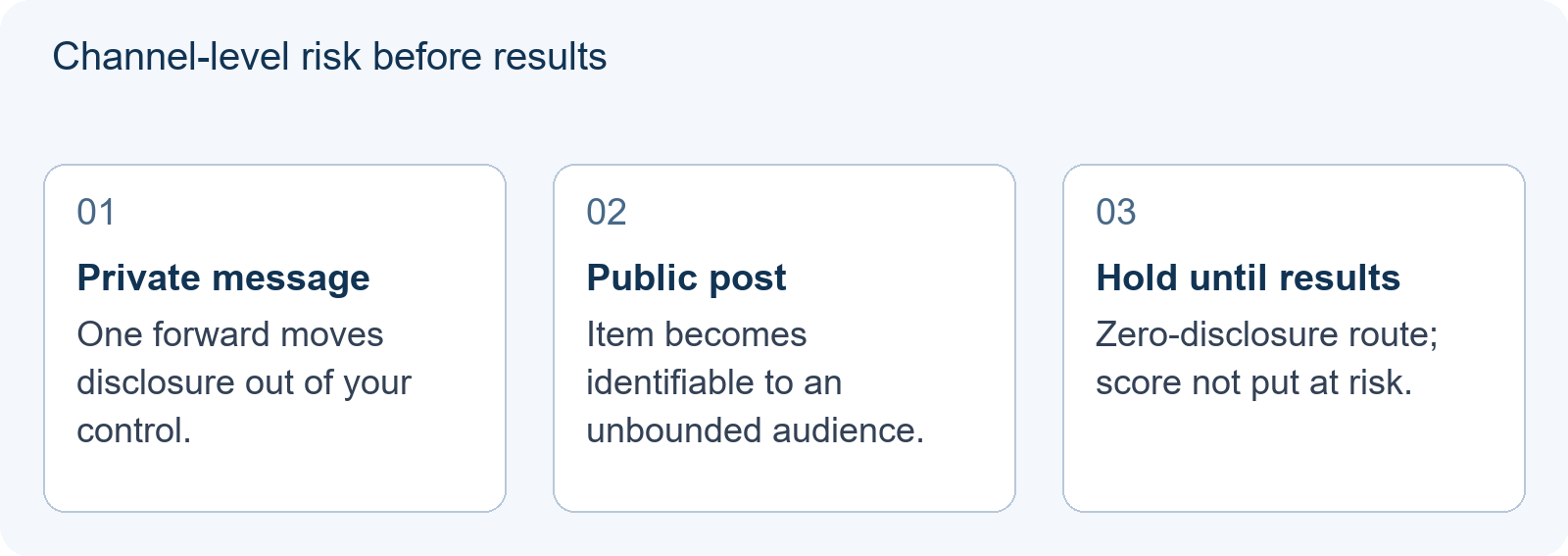
The participant notes do not describe any monitoring mechanism, and we should not invent one. What they do establish is chain of responsibility: the student is responsible for non-disclosure, and a leak cancels the score. Two structural features of messaging make that responsibility hard to manage.
First, once a message or screenshot is forwarded, it is out of the original sender’s control. A single forward turns a private comparison into a public disclosure that the first sender cannot retract, delete or disclaim. Whatever the original intent, the record now exists off-device.
Second, contest organisers generally assume that test items may still need to remain out of circulation while marking, verification and subsequent stages are completed. Even if a particular item is never reused, premature exposure creates a fairness question the organiser cannot ignore. The manageable fact for students is that only the first message is within their control; everything after it is amplification by other hands.
What parents, tutors and school groups should do
The participant notes place the non-disclosure obligation on the student. In practice, adults are part of the channel that can put a student at risk, so they need a clear protocol.
- Week of the exam. Agree a stated “no questions, no screenshots” rule that starts the moment the student closes the exam browser and ends only when the official results page updates.
- Coaches and tutors. Do not run a post-mortem on remembered questions while results are pending. Debrief the strategy that got the student to the exam — timing, scratch-paper habits, source of any careless errors — and defer item-level review until results are published.
- School registration units. Brief staff and students before the exam date. A “share your problems so others can practise” message, however well-intentioned, can push a student over the line.
Parents may help set up both cameras before the exam and may help take the answer-list photo at the end — those are explicitly permitted. None of that authorises post-exam discussion of question content.
For the equipment side — the two-camera setup, what clears the desk, and the other conditions that void a result — see our guide to the Math League Online Preliminary Round (12 December 2026): The Two-Camera Setup, What Voids a Result, and a Home Rehearsal Plan for China Families.
Consequence: score cancellation
The notes are explicit: a leaked test question cancels the score. There is no graduated schedule (no first-warning step) in the participant notes, and no stated appeal route for the leak itself. Treat the rule as binary.
A cancelled preliminary score means the student has no preliminary result from that attempt for the season. If the family is aiming at the semi-final stage, that loss can end the pathway for that attempt, not just the scoring for that day.
It is equally important to see what the notes are not saying. They are not banning private discussion of the exam experience in general; they are banning disclosure of test questions specifically. They are not claiming a permanent publication ban; the prohibition ends when results are announced. And they do not define a numerical tolerance for “partial hints” — the operative language is “in any form,” and the test is whether a test question is disclosed.
After results are announced: the legitimate review path
Once results are out, the participant notes describe the following materials as accessible on the official site after signing in.
| Resource | What it contains |
|---|---|
| National preliminary statistics | Normal distribution graph, average score, standard deviation and related figures for the preliminary population |
| Personal score report | Which questions were answered correctly, aligned knowledge points and difficulty levels |
| Targeted practice questions (Grades 3-12) | Practice items generated from the student’s own preliminary paper to address knowledge gaps |
This is the intended review cycle, and it explains why the disclosure ban is not as restrictive as it first sounds. Personal item-level feedback becomes available through the official channel on the organiser’s schedule, not through peer exchange.
If you dispute the grading, the notes describe one specific mechanism: the organising committee compares the photo of your answer list — the one you are required to take before submission, and again during the 2-minute photo window if the automatic redirect fires — against the system-recorded responses. That is a grading-accuracy check, not an exception to the disclosure rule. Taking a clear answer-list photo with your name and test number visible is the preparation you control for that possibility.
To rehearse the end-of-exam answer entry and submission check before the live date, see our Math League Online Practice: Rehearse Answer Entry and the Final Submission Check.
A three-step integrity routine for the exam day
Step 1 — Before you submit. Confirm the answer-list photo shows your name and the test number clearly. This photo is what you will rely on if you later dispute the grading.
Step 2 — Immediately after you submit. Close the exam tab, put the phone down, and do not type or say anything about question content — to friends, to group chats, or to family. Answer “how was it?” with “I will tell you after results” and change the subject.
Step 3 — Between submission and results. Track the official announcement channel on the Math League news and results pages. Do not accept or forward any screenshot, list or voice note of test questions. If one arrives, delete it and do not pass it on.
Applying the Rule: A Diagnostic for “Identifiable” Disclosure
The participant notes prohibit disclosing test questions “in any form.” The critical operational question is not whether you shared a screenshot, but whether your description allows another student to identify a specific item. This distinction determines if a casual conversation crosses into score-cancellation territory.
Teaching Illustration: Consider two post-exam messages sent before results are announced.
- Message A: “Question 12 was about finding the area of a triangle with vertices at (0,0), (4,0), and (1,3).”
Verdict: Violation. The coordinates uniquely define the problem. Any student who sees this can reconstruct the exact question, effectively sharing it. - Message B: “There were several geometry problems involving coordinate planes. I found them tricky because I forgot the distance formula.”
Verdict: Safe. No specific item is identifiable. It describes a topic category and personal difficulty, not a unique question instance.
Diagnostic Check: Before sending or saying anything, ask: “If I gave this description to a stranger, could they find the exact question in their own exam paper?” If yes, do not share it. If no, it is likely general commentary.
Next Practice Task: During your next mock exam review, practice summarizing your performance using only Message B-style language. Focus on strategy failures (e.g., “I spent too long on algebra”) rather than content specifics (e.g., “The quadratic equation had complex roots”). This builds the habit of safe communication while preserving the integrity of the preliminary round.
General event background is available at Event background.
This is an independent preparation guide, not affiliated with, endorsed by, or sponsored by Math League.
Frequently Asked Questions
Can I discuss questions from memory with friends once I have submitted?
No, not before results are announced. The prohibition covers sharing or disclosing test questions ‘in any form,’ and reconstruction from memory is a form. General talk about timing or difficulty is a different category, but the moment a specific item is identifiable from what you say, you are inside the ban.
My tutor usually reviews the paper with me the same week. Can we do that this time?
Wait. Reviewing remembered content with a tutor is still disclosure of test questions before results. Use the session for process feedback — timing, scratch-paper habits, source of careless errors — and hold item-level review until the results are published and the official score report and targeted practice questions are available.
If I think my score is wrong, can I dispute it — and does that risk anything under the disclosure rule?
Grading disputes and the disclosure rule are separate. The notes describe a dispute mechanism based on comparing your answer-list photo against the system-recorded responses. Filing a dispute is not itself a disclosure of test questions. Keep the dispute focused on your own answer record and do not attach or share the question text.