Sitting the 2026-27 Math League preliminary round online takes two devices — a laptop or tablet with a camera, and a smartphone with a camera and microphone — plus an ID upload and equipment check at least two weeks before 12 December. Once the paper starts, leaving either camera's view, or anyone else appearing in it, automatically invalidates the result. The step easiest to forget is photographing the answer list before you submit.
Online or written: make this choice first
The organiser's 2026-27 preliminary round page lists two ways to sit the paper: written, or online by logging in to the Math League system and answering in a web browser. Which of the two your student can use depends on the institution or school that registers them — the page directs families to register there — so ask before planning anything else. Note that the organiser's page on online integrity opens by saying the 2026-27 preliminary will be held online, while the main page lists both modes. Your registering institution's answer is the one that counts.
The published slots all fall on Saturday 12 December 2026:
- Contest registration
- Free past papers
- 1-on-1 trial lesson

| Grade | Online slot | Written slot | Paper |
|---|---|---|---|
| Grades 1–2 | 1:30–2:15 PM | 9:00–9:45 AM | About 50 multiple-choice questions, 45 minutes |
| Grades 3–4 | 1:30–2:45 PM | 11:00 AM–12:15 PM | About 40 multiple-choice or fill-in-the-blank questions, 75 minutes |
| Grade 5 | 11:00 AM–12:15 PM | 11:00 AM–12:15 PM | About 40 questions, 75 minutes |
| Grade 6 | 9:00–10:15 AM | 9:00–10:15 AM | About 40 questions, 75 minutes |
| Grades 7–12 | 11:00 AM–12:15 PM | 11:00 AM–12:15 PM | About 40 questions, 75 minutes; grades 8–9 and 10–12 share papers |
For grades 1 to 4, the mode changes the time of day: an online grade 2 child sits after lunch, a written one before ten in the morning. Beyond the clock, four questions usually settle the choice:
- Is the home connection dependable for the whole paper? The notes say any consequences of an unstable or disconnected network are the student's responsibility.
- Is there a room that can be cleared and kept closed? Unrelated items must be removed from the room, including the desk surface, and nobody else may appear in either camera once the paper starts.
- Can the student work alone on camera? Parents may help with set-up, but not during the paper — a real consideration for a six-year-old.
- Are there two suitable devices? One laptop or tablet with a camera for answering, and one smartphone with a camera and microphone for monitoring.
If any answer is no, ask your institution whether the written paper is available and where it is held. If you are still deciding whether the round suits your child at all, start with our overview of what Math League is.
The two-camera layout, device by device
The rules make more sense once you know what each camera is for. The organiser's integrity page says invigilators monitor students live in the background, two for every 60 students, and that the committee reviews every student's recording after the round. The participant notes then set out the layout:
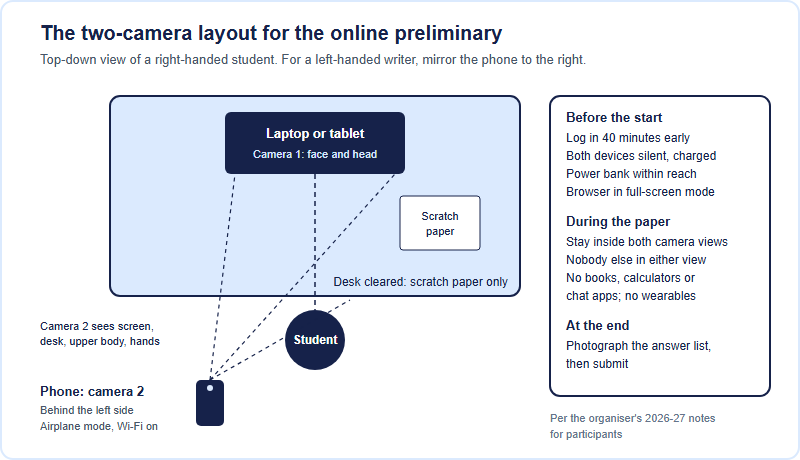
- Camera 1: the laptop or tablet. On at all times, with the student's face and head visible. It is used to confirm that the person answering is the registered student, by comparison with the uploaded ID photo, and to record the sitting.
- Camera 2: the smartphone. Also on at all times, showing the laptop or tablet screen, the desk surface, and the student's upper body and hands. The notes recommend placing it behind the student's left side, or the right side for a left-handed student. Set it to silent and to airplane mode, then switch Wi-Fi back on so it stays connected without taking calls.
- The screen. Answers are entered in a computer browser in full-screen mode. The answer page cannot be switched to another page or application, copy and paste are disabled, and searching online or using instant messaging tools is strictly prohibited.
- The desk. Clean scratch paper only. No books, including dictionaries, no reference materials, calculators, other phones or aids, and no wearable devices on the arms.
- Power, network and clothing. Both devices fully charged, a power bank recommended, and neither used for long periods beforehand, so they do not overheat. The notes also suggest avoiding streaming video, online games and online TV on the home network during the test, and ask students to wear the clothes they normally wear to school.
One more detail belongs in the set-up. The username for the exam system is the phone number supplied at registration through the school or institution, and the organising committee's proctor may call parents if a rule problem is detected during the test. Because camera 2 must sit in airplane mode, that registered number is most useful on a parent's own phone, switched on and with an adult who is out of camera view.
What voids a result, and what cancels a score
The notes describe two kinds of consequence. Some are automatic and happen during the paper; others follow a review afterwards. The automatic ones deserve the most attention, because an entirely honest student can trigger them.
| What happens | When | Consequence in the organiser's notes |
|---|---|---|
| The student leaves the view of either camera, for any reason | After the start, before answers are submitted | Result automatically invalidated |
| Another person appears in either camera | After the start; the answer-list photo is the exception | Result automatically invalidated |
| The connection is unstable or drops | During the paper | Consequences are the student's responsibility |
| Suspected cheating in the recording is confirmed after the committee contacts the student | After the review | Score cancelled |
| Test questions are shared in any form before results are announced | After the paper | Score cancelled |
Read the first two rows as a household problem rather than a student one. A younger sibling wandering in, a grandparent bringing a glass of water, or a child stepping out of frame to fetch a pencil can each end a result with no dishonesty involved. The fix is organisational: a closed door with a note on it, pencils and scratch paper placed before the start, and a bathroom visit before logging in.
There are exactly two moments when an adult may take part. Before the paper begins, parents may help set up and test both devices. At the end, parents may help photograph the answer list and may appear on camera while they do. Between those two moments the room belongs to the student, who may leave the camera view only after answers have been submitted successfully. If something technical goes wrong — questions not displaying properly, or answers that will not enter — the notes say to take photos or videos of the problem and contact the organising committee immediately.
The answer-list photo: the step that protects the score
Before answers are submitted, the system shows the student's answer list on the computer screen. The student must photograph it, and the photo must include their name and the test number the system provides; parents may help take it. If the student later disputes the marking, the organising committee compares that photo with the responses the system recorded — which makes it the family's own record of what was entered.
The clock is forgiving about this step, provided you know how it works. The paper runs 75 minutes, or 45 for grades 1 and 2. If time runs out before the student submits, the system moves automatically to the submission page, which shows the answer list, and allows an extra two minutes to take the photo before submitting. A student who has never seen that redirect may think something has gone wrong; a family that has rehearsed it knows exactly what to do.
Settle three details in advance, and put any you are unsure of to your registering institution: who takes the photo, which device takes it without disturbing the monitoring set-up before submission, and how you will check that the name and test number are legible before anyone presses submit.
A countdown from now to 12 December
The organiser's cut-offs are relative — at least two weeks before, at least 40 minutes in advance — which makes them easy to agree with and easy to miss. Pinned to a calendar, they look like this. The dates are our arithmetic, and the rehearsal is our suggestion rather than a requirement.
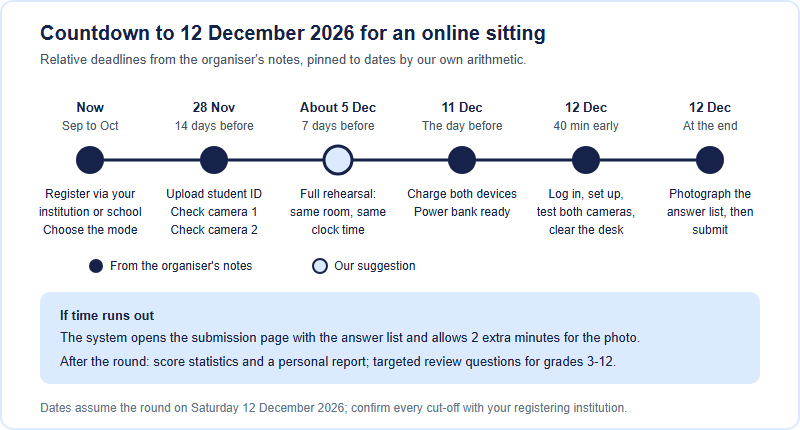
The rehearsal is the step we would least want to skip. Hold it about a week before the round, in the room you will use, at the same clock time as your slot — a grade 6 student at 9:00 AM, an online grade 3 or grade 4 student at 1:30 PM. Run both cameras through a full-length practice paper: about 40 questions in 75 minutes, or about 50 in 45 minutes for grades 1 and 2. From the student's chair, check that the phone frame really holds the screen, the desk and both hands. Agree the household rules, and finish by rehearsing the answer-list photo. Write down everything that went wrong, and fix it that week.
For the mathematics side of the next twelve weeks, our study roadmap sets out a weekly rhythm that fits around school. One reassurance on privacy, from the organiser's integrity page: the ID photo and the recording are used only to determine whether the paper was completed honestly, are not disclosed, and are destroyed after the committee completes its evaluation, which the organiser says is usually within a week of the exam. The full requirements are in the organiser's notes for participants.
Frequently asked questions
What equipment is needed for the online Math League preliminary round?
A laptop or tablet with a camera, plus a smartphone with a camera and microphone. Answers are entered in a full-screen computer browser.
Can a parent stay in the room during the online round?
A parent may help set up beforehand, but no other person may appear in either camera once the paper starts, or the result is invalidated.
When must the ID upload and equipment check be done?
At least two weeks before the round. For 12 December 2026 that means by 28 November, by our count. Confirm the cut-off locally.
What happens if time runs out before submitting?
The system opens the submission page with the answer list and allows 2 extra minutes to photograph it before you submit.
This is an independent guide operated by Hanlin Education for China-based international-school students. It is not affiliated with, endorsed by, or sponsored by the official Math League (mathleague.com). Online sitting rules, equipment requirements, time slots and cut-offs are set each season by the organiser and may change — confirm current details on mathleague.com, on the Asia–Pacific Region Website it links to, and with your registering institution. Errors reported to us are corrected within 7 working days.