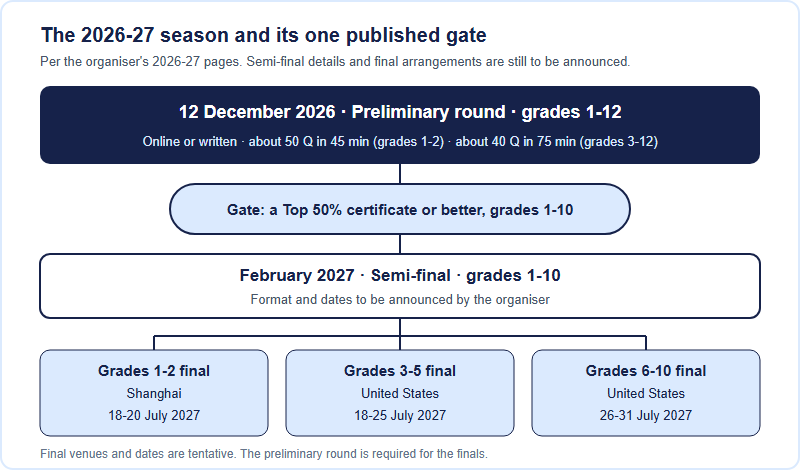
The 2026-27 Math League preliminary round for grades 1 to 12 is on Saturday 12 December 2026, in the same time slots as last season. What changed is the paper: every level now carries more questions on an unchanged clock, and the organiser's Chinese-language page describes a bilingual paper. What did not change is the gate — a Top 50% certificate or better still opens the February semi-final for grades 1 to 10.
Which Math League round this is
Most writing about Math League, including most of this site, concerns its North American school contests: papers for grades 4 to 12 that schools order through mathleague.com, covered in our overview of what Math League is. This round belongs to a different line. The menu on mathleague.com links to a separate Asia–Pacific Region Website, whose season has four parts: a preliminary round for grades 1 to 12, a semi-final and a finals and summer tournament for grades 1 to 10, and an international summer challenge for grades 1 to 12.
Two facts on the 2026-27 preliminary page define it. It is the entry point to everything after it: students who plan to take part in the 2027 finals and summer tournament must first sit the preliminary round. And families do not register with the organiser directly — the page says to register through your own training institution or school, and to contact the organising committee if yours does not organise the round.
- Contest registration
- Free past papers
- 1-on-1 trial lesson

Below, we compare the organiser's 2025-26 and 2026-27 preliminary pages, in English and Chinese, as read in mid-September 2026. The current arrangements are on the organiser's 2026-27 preliminary round page.
The change that matters most: more questions on the same clock
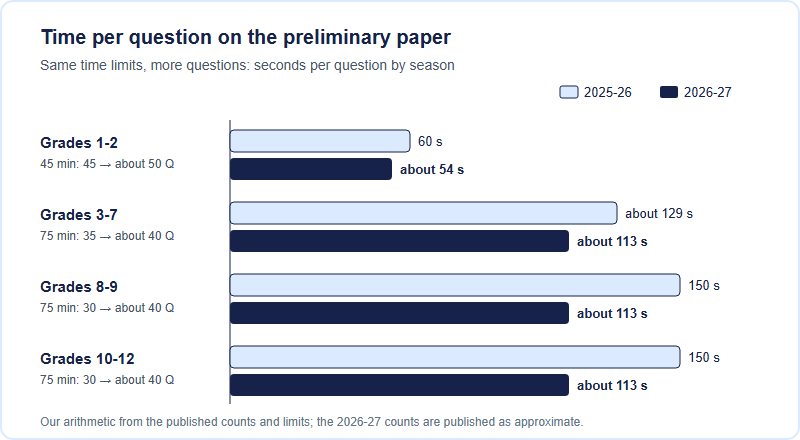
The time limits did not move. Grades 1 and 2 still have 45 minutes, and every other paper still has 75. The question counts moved at every level.
| Paper | 2025-26 questions | 2026-27 questions | Time limit, both seasons | Time per question (our arithmetic) |
|---|---|---|---|---|
| Grade 1 and grade 2 (one paper each) | 45 multiple-choice | About 50 multiple-choice | 45 minutes | 60 seconds → about 54 seconds |
| Grades 3, 4, 5, 6 and 7 (one paper each) | 35 multiple-choice or fill-in-the-blank | About 40 multiple-choice or fill-in-the-blank | 75 minutes | About 2 min 9 s → about 1 min 53 s |
| Grades 8–9 (one shared paper) | 30 | About 40 | 75 minutes | 2 min 30 s → about 1 min 53 s |
| Grades 10–12 (one shared paper) | 30 | About 40 | 75 minutes | 2 min 30 s → about 1 min 53 s |
Read the last two rows first, because they carry the largest change. Last season, grades 8 to 12 answered 30 questions in 75 minutes — two and a half minutes each. This season the page lists about 40, which leaves roughly 1 minute 53 seconds per question: a quarter less time per question, and ten more questions to spend it on. Grades 3 to 7 lose about 16 seconds per question, and grades 1 and 2 about six.
It is tempting to read more questions as easier questions. Neither page says anything about difficulty, so treat that as unknown. What is certain is the time budget, and the budget changes how a student should practise:
- Retime older practice papers. A paper written to last season's count trains last season's rhythm. Count its questions and allow about 113 seconds each for grades 3 to 12, or about 54 seconds each for grades 1 and 2. That comes to roughly 66 minutes for a 35-question paper, 56 minutes for a 30-question paper, and 40 minutes for a 45-question grade 1 or grade 2 paper.
- Decide in advance when to move on. On a tighter clock, one stubborn question costs two answerable ones. Set a personal ceiling — for example, twice the average time per question — and practise leaving a question when you reach it.
- Keep the arithmetic by hand. The organiser's notes for the online sitting allow only clean scratch paper and prohibit calculators, dictionaries and reference materials, so written calculation speed now counts for more. Our study roadmap shows where pace work belongs in a term of preparation.
A bilingual paper, according to the Chinese-language page
The second change does not appear on the English-language page at all, which makes it easy to miss. The organiser publishes a Chinese-language version of each season's page, and on the question of paper language the two seasons read differently.
- 2025-26. For grades 3 to 12, the Chinese-language page described every question as an original English question, with an online English–Chinese list of common maths vocabulary provided to each student during the test. Grade 1 and 2 questions were described as mostly using pictures rather than English words.
- 2026-27. The Chinese-language page lists the paper language as bilingual, Chinese and English, and says every English question comes with a Chinese translation.
For a student whose mathematics runs ahead of their English maths vocabulary, that removes a genuine barrier. It does not remove the clock. Reading both versions of every question is a quiet way to lose the time the new question counts have already taken: fifteen extra seconds per question comes to ten minutes across 40 questions, more than an eighth of a 75-minute paper. Settle in practice which version you read first, and when you check the other, rather than improvising on the day — and confirm with your registering institution how the translation is laid out.
What did not change: the date, the certificates and the gate
The calendar shape is identical. Last season's round fell on Saturday 6 December 2025 and this season's falls on Saturday 12 December 2026, and every published slot keeps last year's clock times in both modes. Grade 6 sits from 9:00 to 10:15 AM in either mode; grades 5 and 7 to 12 sit from 11:00 AM to 12:15 PM in either mode; grades 1 to 4 have separate online and written slots. The page does not name a time zone, so confirm your slot with the institution that registers you.
The certificates are unchanged as well. Each student is ranked within their grade group and receives one of four certificates, and the Chinese-language page adds that the four are not awarded in combination:
- Honor Roll of Distinction Certificate — the top 8% of the grade group.
- Honor Roll Certificate — the top 25%.
- Certificate of Achievement — the top 50%.
- Certificate of Participation — every other participant.
The gate follows from those tiers. Students in grades 1 to 10 who receive any of the first three certificates are eligible for the semi-final — so the line to clear is the middle of your grade group, not the top 8%. Grades 11 and 12 can sit the paper and earn certificates, but the semi-final is published for grades 1 to 10 only. That semi-final is scheduled for February 2027 with details still to come, and the finals are tentatively planned for July 2027: Shanghai for grades 1 and 2, the United States for grades 3 to 10.
One detail changes who a student is ranked against. Grades 8 and 9 sit the same paper and are ranked together rather than grade by grade, and the page says the same applies to the high school group, which sits one paper across grades 10 to 12; the certificate states the grade group. Two consequences follow. A grade 8 student competes for the same percentile as grade 9 students on an identical paper. And a grade 10 student is ranked alongside grades 11 and 12, while being the only year in that group for whom the semi-final is open.
For calibration, per our own records: in 2024-25, about 85% of one Hanlin preparation cohort cleared the preliminary into the semi-final, and some of that group went on to the final. That describes a prepared group in a past season, not a forecast for any individual student.
What to settle between now and 12 December
Everything after the preliminary depends on a clean 12 December, and most of what decides that day happens in the next twelve weeks — very little of it mathematics.
- Registration through the right door. Ask your institution or school when it needs enrolment details. For the online sitting, the organiser's notes say the login username is the phone number given at registration, and a proctor may call parents during the paper if a rule problem is detected, so that number needs to be reachable on the day.
- The mode. Online and written are both listed, with different slots for grades 1 to 4. Online adds an ID upload and an equipment check for two cameras at least two weeks before the round — by 28 November, by our count.
- The paper your student actually sits. Confirm the grade group, especially for students in year-based school systems or near the boundaries of the shared papers. Our grade-band guide works through the placement questions that come up most often.
- A retimed practice rhythm. Short, frequent sessions at the new pace, by hand, from now until December, rather than a burst of long papers in the final fortnight.
- A plan for the report. Every student receives national score statistics (a distribution graph, average and standard deviation) and an individual report showing each question's result, topic and difficulty; grades 3 to 12 also receive targeted review questions built from their own paper. Block out December time to use them.
Finally, keep the certificate exactly as issued. The organiser says the list of preliminary winners will be announced on mathleague.com, and describes results as an important reference when applying to well-known high schools and universities in North America. A named tier and grade group, backed by a published list, is something an admissions reader can check against a transcript and an activity list — and that corroboration, not the certificate alone, is what makes a record believable. No single certificate decides an outcome.
Frequently asked questions
When is the 2026-27 Math League preliminary round?
Saturday 12 December 2026, for grades 1 to 12, online or written. Slots vary by grade and mode, so confirm yours with your institution.
How many questions are on the 2026-27 preliminary paper?
About 50 multiple-choice questions in 45 minutes for grades 1 and 2, and about 40 questions in 75 minutes for grades 3 to 12.
What result is needed to reach the semi-final?
A Top 50% certificate or better. Grades 1 to 10 ranked in the top half of their grade group are eligible for the February semi-final.
Is the 2026-27 preliminary paper in Chinese?
According to the Chinese-language page of the organiser, the paper is bilingual, with a Chinese translation for every English question.
This is an independent guide operated by Hanlin Education for China-based international-school students. It is not affiliated with, endorsed by, or sponsored by the official Math League (mathleague.com). Round dates, paper formats, certificate rules and registration arrangements are set each season by the organiser and may change — confirm current details on mathleague.com and the Asia–Pacific Region Website it links to. Figures from our own records describe past cohorts and do not predict individual results. Errors reported to us are corrected within 7 working days.