Yes — a child in grade 1, 2 or 3 can take part in Math League, through its Asia–Pacific region rounds rather than the North American school contests, which begin at grade 4. On Saturday 12 December 2026, grades 1 and 2 sit about 50 multiple-choice questions in 45 minutes. Grade 3 moves to about 40 multiple-choice or fill-in-the-blank questions in 75 minutes — the only point on the 2026-27 preliminary ladder where the format changes.
Two starting grades under one name
A parent looking for Math League for a six- or seven-year-old could easily conclude that it does not exist, because mathleague.com describes contests for grades 4 through 8, Algebra 1 students and high school students. That is accurate for the North American school contests, which our overview of what Math League is explains.
The menu on mathleague.com also links to a separate Asia–Pacific Region Website, and the season published there starts much earlier. Its 2026-27 activities list a preliminary round for grades 1 to 12, a semi-final and a finals and summer tournament for grades 1 to 10, and an international summer challenge for grades 1 to 12, scheduled for August 2027 with details to come. The preliminary page says interested students register through their own training institution or school, and should contact the organising committee if theirs does not organise the round.
- Contest registration
- Free past papers
- 1-on-1 trial lesson

Everything below refers to that second ladder, as published on the organiser's 2025-26 and 2026-27 pages in mid-September 2026. Grade numbers follow the organiser's; if your child's school counts in years, confirm which paper they would sit with the registering institution. For grade 4 and above, our grade-band guide covers placement.
Grades 1 and 2: what the first paper asks of a young child
Grades 1 and 2 each sit their own paper of about 50 multiple-choice questions in 45 minutes, which works out at roughly 54 seconds a question. Last season's papers had 45 questions in the same 45 minutes, so the pace has tightened a little.
What the questions look like is less settled. The 2025-26 page described grade 1 and 2 questions as mostly using pictures rather than English words to test thinking, and stressed that these were not plane geometry questions but images used to assess reasoning. The 2026-27 page does not repeat that description, and the organiser's Chinese-language page now describes the whole paper as bilingual, with a Chinese translation for every English question. Treat last season's description as a guide to style rather than a promise, and ask your registering institution what the current paper looks like.
Online, grades 1 and 2 sit from 1:30 to 2:15 PM; the written paper runs from 9:00 to 9:45 AM (the page names no time zone, so confirm locally). The mode matters more for a young child because of the online rules: once the paper starts, no other person may appear in either camera and the student may not leave the camera view, or the result is invalidated. A six-year-old sitting online is on their own for the full 45 minutes; if that sounds like a stretch, ask whether the written paper is available.
After the round, every participant receives national score statistics and an individual report showing whether each question was answered correctly, with its topic and difficulty. The organiser lists targeted review questions for grades 3 to 12, so for grades 1 and 2 the individual report is the main feedback tool. Go through it together in December: read alongside your child's own account of each miss, it can show whether the trouble was the idea, the reading or the rush.
Certificates use the same four tiers as other grades — top 8%, top 25%, top 50% and participation — ranked within the grade, so roughly half of each grade receives participation. For a first round, the top 50% line is the sensible target, and the one with consequences: a Top 50% certificate or better makes a grade 1 to 10 student eligible for the semi-final.
Grade 3: the only point where the format changes
From grade 3 to grade 12, every 2026-27 preliminary paper has one shape: about 40 multiple-choice or fill-in-the-blank questions in 75 minutes. The ladder's single change of format falls between grades 2 and 3, and it changes several things at once.
| 2026-27 | Grade 2 | Grade 3 |
|---|---|---|
| Questions | About 50 | About 40 |
| Question type | Multiple-choice | Multiple-choice or fill-in-the-blank |
| Time limit | 45 minutes | 75 minutes |
| Time per question (our arithmetic) | About 54 seconds | About 1 minute 53 seconds |
| Online slot, 12 December 2026 | 1:30–2:15 PM | 1:30–2:45 PM |
| Written slot, 12 December 2026 | 9:00–9:45 AM | 11:00 AM–12:15 PM |
| Targeted review questions after the round | Not listed | Listed (grades 3–12) |
| 2027 final, tentative | Shanghai, 18–20 July | United States, 18–25 July |
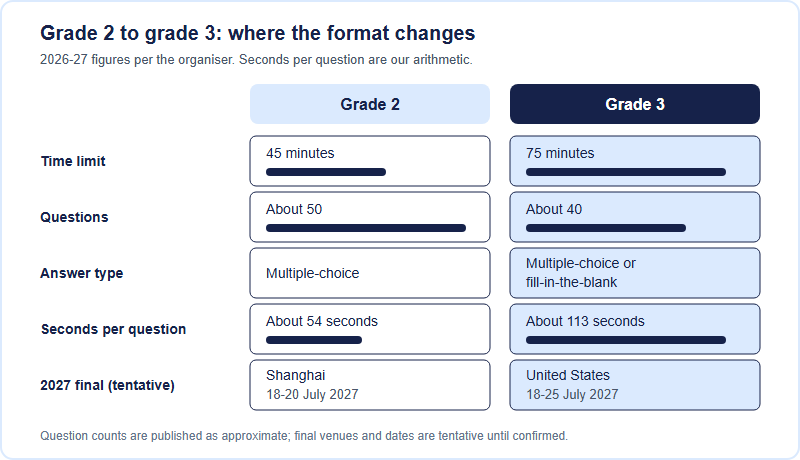
Three of those changes are worth preparing for deliberately.
- Stamina. Seventy-five minutes is half an hour longer than the grade 2 paper, and a long time for an eight-year-old to concentrate alone. Build it the way you would build any endurance: practice sessions that lengthen from about 30 minutes to the full 75 over several weeks, rather than a first full-length attempt in December.
- Answers without options. A fill-in-the-blank question removes the chance to recognise the right answer among choices or to rule out wrong ones. The child has to produce the answer and enter it exactly, so children used to choosing from options need regular practice writing their own — including checking that what they wrote is what they meant.
- A different pace. About 113 seconds per question is roughly double the grade 2 rate. The extra time is best spent reading carefully and checking, not lingering; a child who has spent several minutes on one question should learn to move on and come back.
If your child is in grade 2 this year, next December's paper will be in the grade 3 format, if the organiser keeps it; the spring and summer of grade 2 are a comfortable time to introduce fill-in-the-blank practice and longer sessions. On the North American school contests, mathleague.com describes the grade 4 to 8 and Algebra 1 papers as multiple-choice and does not state the answer format for its high school contests; on this ladder the fill-in-the-blank option arrives at about eight years old.
Where a young child's season can lead
A Top 50% certificate or better opens the semi-final, scheduled for February 2027 with details still to come. The final is where the two lanes separate: the organiser tentatively lists Shanghai from 18 to 20 July 2027 for grades 1 and 2, the United States from 18 to 25 July for grades 3 to 5, and the United States from 26 to 31 July for grades 6 to 10.
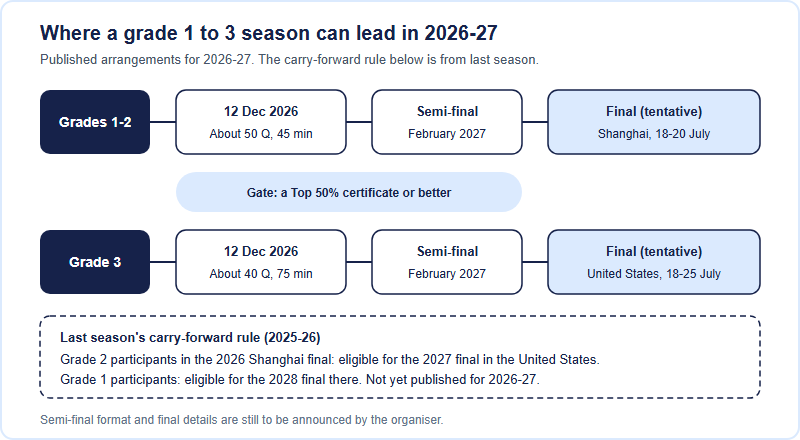
Last season's pages suggest how the rest might work — read them as precedent, not as this year's rules:
- The 2025-26 semi-final was open-book. Students downloaded the paper and submitted answers online by 23:59 on 15 February 2026; the system then selected about five questions for each student to explain in a voice recording, with six minutes per question. Grades 1 and 2 formed their own group with their own questions.
- Grade 1 and 2 students with outstanding combined scores across the preliminary round and the semi-final were eligible to apply for the final.
- The 2026 grades 1 and 2 final ran in Shanghai from 19 to 21 July 2026, from 9:00 a.m. to 5:00 p.m. each day, with individual and team finals.
- The 2026 grades 3 to 5 final ran in the United States from 12 to 19 July 2026 at The College of New Jersey, in a closed-campus format.
- A carry-forward rule. Second-grade participants in the 2026 Shanghai final became eligible for the 2027 final in the United States, and first-grade participants for the 2028 final there.
That last rule is the one for grade 1 and 2 families to watch. If the organiser repeats it for 2026-27 — it has not been published yet — a grade 2 child at the 2027 Shanghai final would become eligible for the 2028 final in the United States, and a grade 1 child for the 2029 one. Until the details appear, treat that as a question to ask rather than a plan. Grade 3 in the United States final is also a recent arrangement: the organiser's archive links to earlier elementary finals are labelled grades 4 to 5, while the 2026 and 2027 pages list grades 3 to 5. For a grade 3 family, a final would mean about a week in the United States, so travel documents are worth a thought before February.
Is this the right year? A parent checklist
A first contest at six, seven or eight should feel like a reasonable challenge, not a verdict. Five questions help decide whether this season fits:
- Can your child concentrate alone for the whole paper? That is 45 minutes for grades 1 and 2 and 75 for grade 3, with no adult in view if sitting online.
- Can they read the questions independently? A bilingual paper lowers the language barrier, but reading still takes time on a fixed clock.
- How will they take a certificate from the bottom half? Roughly half of each grade receives participation. If a first result would discourage rather than inform, frame the round as a measurement and put the individual report at the centre.
- Which mode suits your household? Online needs two devices with cameras, a closed room and a steady connection; ask whether the written paper is available locally.
- Would a final involve travel you can support? Shanghai for grades 1 and 2, the United States for grade 3 and above, on the tentative 2027 plan.
If most answers are yes, the season is a low-stakes way to meet contest conditions early; if several are no, waiting a year costs little, because the ladder runs to grade 12. Either way, the short, regular practice habit in our study roadmap suits young children better than occasional long sessions.
Frequently asked questions
Can a grade 1 student take part in Math League?
Yes, through the Asia-Pacific region rounds. The 2026-27 preliminary round lists grades 1 to 12, registered through an institution or school.
How long is the Math League paper for grades 1 and 2?
45 minutes for about 50 multiple-choice questions in 2026-27. Grade 3 moves to about 40 questions in 75 minutes.
Where would a grade 1 or grade 2 child sit the 2027 final?
In Shanghai, tentatively from 18 to 20 July 2027, per the organiser. Grades 3 to 5 are tentatively planned for the United States.
Do grades 1 and 2 get targeted review questions?
The organiser lists targeted review questions for grades 3 to 12. Grades 1 and 2 receive score statistics and an individual report.
This is an independent guide operated by Hanlin Education for China-based international-school students. It is not affiliated with, endorsed by, or sponsored by the official Math League (mathleague.com). Grade ranges, paper formats, venues, dates and eligibility rules are set each season by the organiser, and arrangements described here as last season's may not repeat — confirm current details on mathleague.com and the Asia–Pacific Region Website it links to. Errors reported to us are corrected within 7 working days.