Math League publishes a specific date for each 2026-27 contest, so a season is not something you fit in later — it is nine dates you either put in the calendar in September or miss. The six high school contests run from October to March and finish before the May examination block. The spring paper carries the widest window, and Math League also notes that alternate contest dates may be scheduled one week after a contest date in the event of a scheduling conflict.
Two calendars, one student
Most competition advice treats a season as free-standing. For a student in an IB, AP or A-Level programme it is not: it runs on top of a school calendar that already has its own peaks, and the peaks do not politely avoid each other. The useful exercise takes about twenty minutes and happens once, in September — lay the two calendars side by side and mark the weeks where they overlap.
The Math League side has an unusually plannable shape. The high school competition is a season of six contests rather than one sitting, each six short-answer questions in 30 minutes with no partial credit, and each on a date the organisation publishes in advance. That last detail is what makes this article possible: you are not planning around a vague season, you are planning around known Tuesdays. If the structure itself is new to you, our overview of what Math League is covers it before you start scheduling.
- Contest registration
- Free past papers
- 1-on-1 trial lesson

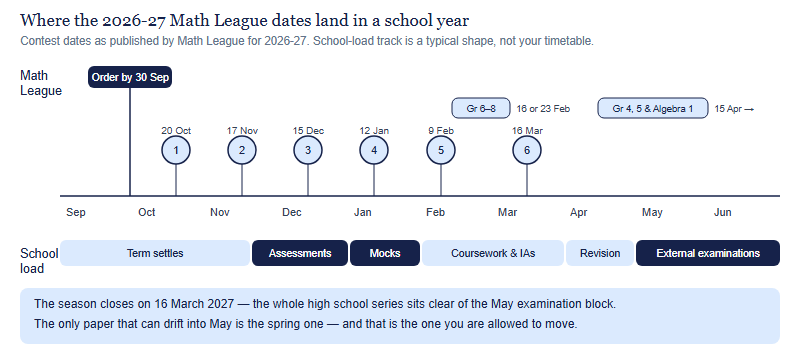
The school side has a shape too, and it is broadly common across Chinese international schools whichever curriculum they run: a settling autumn, a heavy internal-assessment stretch from late November, a mock-examination block in January, a coursework and internal-assessment crunch through February and March, and then the external examination season from early May. Your own school's calendar and your examination board are the authority on your exact dates — the pattern described here is a planning shape, not a timetable.
The 2026-27 dates, and what each one lands on
The table below pairs Math League's published 2026-27 dates with the part of the school year each one tends to fall in. Every one of the six high school contests falls on a Tuesday, roughly a month apart. Registration deadlines differ by band, which is the detail that catches most schools.
| Stage | Published 2026-27 date | What it usually lands on | The move |
|---|---|---|---|
| High school registration closes | 30 September 2026 | Term still settling; no contest is visible yet | Confirm with your coordinator that the order is placed |
| High school contest 1 | Tuesday 20 October 2026 | Early term, light load | The cheapest contest to prepare for — use it as the baseline |
| High school contest 2 | Tuesday 17 November 2026 | Assessment season beginning | Keep practice short and weekly, not blocked |
| High school contest 3 | Tuesday 15 December 2026 | End-of-term assessments | Expect a dip here; do not read it as a trend |
| High school contest 4 | Tuesday 12 January 2027 | Just back from the winter break, ahead of most mock blocks | Two or three short sessions in the first week back |
| High school contest 5 | Tuesday 9 February 2027 | Coursework and internal-assessment crunch | The contest most often lost to admin, not difficulty |
| High school contest 6 | Tuesday 16 March 2027 | Late in the crunch, before the examination run-in | Season closes here — clear of May |
| Grades 6, 7 and 8 | Tuesday 16 or Tuesday 23 February 2027 | Mid-spring term | A genuine choice of two dates — pick the lighter week |
| Grades 4, 5 and Algebra Course 1 | 15 April 2027 or later | Runs into the external examination season | Book April deliberately, not May by default |
Three pressure points, and what to do about each
One: the deadline nobody feels. The high school series closes on 30 September 2026, three weeks before anything happens. It catches more schools than the other two pressure points combined, for three reasons: it arrives while the term is still settling, it is a teacher's task rather than a student's, and missing it produces no visible event — the season simply never starts. There is no student-facing sign-up to fall back on, because these contests are ordered by schools. If you intend to compete this year, the single highest-value thing you can do is ask your coordinator, this week, whether the order has gone in.
Two: the December-January pair. Contest 3 falls on 15 December 2026, inside end-of-term assessments, and contest 4 on 12 January 2027, in the first full week back. This is where scores dip, and the dip is almost always circumstantial rather than mathematical. Two things help. Expect it, so that a weak December does not get read as a downward trend in a six-point series. And note that 12 January sits ahead of most schools' mock-examination blocks, which usually run later in the month — so contest 4 is often more protectable than families assume, provided the date is already in the calendar rather than discovered the weekend before.
Three: the spring paper that drifts into May. Grades 4, 5 and Algebra Course 1 are listed as 15 April 2027 or later. Read carelessly, "or later" becomes May by default, which puts a contest on top of the external examination season. Read deliberately, it is the widest genuine latitude in the whole calendar. If your school sits Algebra Course 1, ask in February for a date in the second half of April. Asking in February is a scheduling question; asking in May is a favour.
Where you actually have a choice — and where you do not
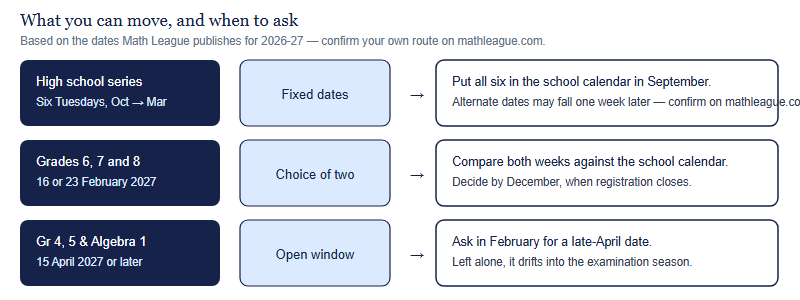
This is the distinction worth internalising, because it determines what is worth negotiating and what is worth simply accepting. Most of the calendar runs on published dates and the right response is to plan around them. Two bands carry a choice built into the schedule, and Math League notes that alternate contest dates may be scheduled one week after a contest date in the event of a scheduling conflict.
- Published dates: the six high school Tuesdays. Math League notes that an alternate date may be scheduled one week later where a conflict arises, so the planning task is still to get all six into the school calendar in September, alongside the assessment dates, so nobody schedules a field trip on top of contest 5.
- A choice of two: grades 6, 7 and 8 are offered 16 or 23 February 2027. One of those two weeks will be materially lighter at your school. Someone should look at the school calendar and pick, rather than defaulting to whichever the coordinator notices first.
- An open window: grades 4, 5 and Algebra Course 1, from 15 April 2027. This is the one date you can genuinely steer, and the one most often left to drift.
One further scheduling fact makes attendance matter more than it looks. In the high school series a school's team score on each contest is the sum of its five highest individual scores that day. A strong student absent on a contest Tuesday does not only lose their own six questions; they remove a contributing score from the team total for that round. That is a good argument for treating the six dates as fixtures from September rather than as optional Tuesdays.
What a season actually costs per week
The honest answer is smaller than families expect, and the shape of the cost matters more than the total. Six contests at 30 minutes each is three hours of contest time across an entire school year. The preparation around it is what needs designing, and it needs designing as a habit rather than a block, because blocks are exactly what a January mock timetable destroys.
Two short weekly sessions — fifteen to twenty minutes each — survive an assessment term in a way that a two-hour Saturday session does not. There is also a specific piece of work that suits this format unusually well this year. Math League has stated that from September 2026 calculators are no longer permitted on any of its contests, which means by-hand arithmetic fluency is now part of preparation for every band. Fluency is built by frequency, not by duration, so the change actually favours the student with fifteen spare minutes on a Tuesday over the one with a free Sunday. Our study roadmap sets out what to put in those sessions.
One caution on ambition. A six-contest series rewards consistency across the year rather than a single strong showing, so a plan that assumes you will be at full capacity in February is a plan that will disappoint you in February. Build the plan around your worst month, not your best.
Deciding in September what you will defend
The decision differs by year group, and it is worth making explicitly rather than by drift.
- Pre-examination years (roughly grades 9 and 10). Protect the whole season. There is no external examination conflict, the load is lighter, and this is where a six-point record gets built. Check which grade band applies to you first — our grade-band guide settles that.
- Examination years. Name two or three contests you will genuinely sit, and treat the rest as optional. October, November and January are the realistic candidates; February and March compete directly with coursework deadlines. Naming them in September is what stops the whole season quietly evaporating in December.
- Anyone sitting Algebra Course 1. Book April. This is a one-sentence decision that removes an entire collision, and it has to be made months before it feels urgent.
There is a longer-run reason to make the September decision properly, and it is not about any single score. A record of six contests sat across a full academic year, alongside a transcript that shows the same subject going well, reads to an admissions officer as one coherent story rather than two unrelated claims — the competition record and the school record corroborate each other. That cross-checking is what makes a file believable. A single contest sat in isolation carries much less of that weight, which is an argument for starting the year properly rather than for cramming later. No competition result decides an outcome on its own; what a full, well-scheduled season does is make the rest of the picture easier to trust.
Frequently asked questions
Does the Math League season clash with AP, IB or A-Level exams?
Not the high school series. Its six 2026-27 contests run 20 October to 16 March, finishing before the May examination block.
Can our school move a contest to a different day?
Math League publishes a set date for each high school contest and notes that alternate contest dates may be scheduled one week after the contest date in the event of a scheduling conflict. Confirm your own arrangement on mathleague.com.
Which 2026-27 date can we actually choose?
Grades 6 to 8 pick 16 or 23 February 2027, and grades 4, 5 and Algebra Course 1 sit on 15 April 2027 or later. Math League also notes that alternate contest dates may be scheduled one week after a contest date where there is a conflict.
When must our school register for the high school series?
Math League lists 30 September 2026. Routes vary by region, so confirm your own deadline on mathleague.com.
This is an independent guide operated by Hanlin Education for China-based international-school students. It is not affiliated with, endorsed by, or sponsored by the official Math League (mathleague.com). Contest dates, registration routes, deadlines and materials rules are set per edition and per region — confirm current details on mathleague.com. Examination dates, mock timetables and internal assessment deadlines are set by your school and your examination board. No competition result guarantees any admission outcome. Errors reported to us are corrected within 7 working days.