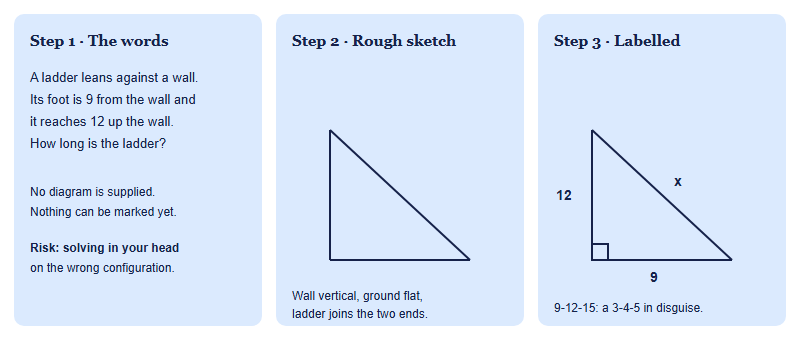
Geometry on Math League is unusual for one reason: the question is written in words, and the picture is your job. Most lost marks happen before any calculation, in the thirty seconds when a student reads a configuration and never draws it. This guide covers the five moves that come first, the exact-value toolkit that matters now calculators are gone, and what geometry looks like at each grade band.
Why geometry behaves differently from every other topic
Number theory, counting and algebra all arrive as symbols you can start manipulating immediately. Geometry can arrive as a sentence describing an object that does not yet exist on your page. A typical phrasing gives you a rectangle, a point on one side, a segment drawn to an opposite corner, and asks for an area — and none of that is visible until you make it visible.
This creates a specific failure mode that shows up repeatedly in practice: a student who can compute perfectly gets the wrong configuration, then computes flawlessly on the wrong figure. The arithmetic is not the problem. The reading is. And under a 30-minute time limit, the instinct is to skip drawing precisely because it feels like it costs time — which is exactly backwards, because a redrawn figure costs far more than a first one.
- Contest registration
- Free past papers
- 1-on-1 trial lesson

There is a second structural reason geometry deserves attention. Math League states on mathleague.com that on each high school contest the final two questions are generally more difficult than the first four. Geometry configurations are a plausible fit for that back end, though Math League does not publish which topics fall where, because a compound figure gives the setter an easy way to require two ideas rather than one. If you are working out where your marginal study hour should go, the back half of the paper is where a geometry habit pays.
The five moves before any calculation
Treat these as a fixed sequence. They take under a minute once trained, and they convert most mid-paper geometry from a puzzle into a routine.
- 1. Draw it, roughly to scale. Not a neat diagram — a workable one. A figure drawn badly out of scale invites you to assume a wrong relationship; a figure drawn roughly to scale lets your eye reject impossible answers.
- 2. Label every given immediately. Every number in the sentence goes onto the figure before you think about the question. Numbers left in the text get forgotten.
- 3. Mark what is equal. Equal sides, equal angles, parallel marks, right-angle squares. Most geometry questions are solved by noticing an equality you were told about but never marked.
- 4. Hunt for the right triangle. If there is no right triangle, ask whether dropping one perpendicular creates one. An enormous share of contest geometry reduces to a right triangle you had to build yourself.
- 5. Name the unknown, and name what is asked. Write x = the thing you are solving for, and separately write the quantity the question wants. They are often different — the question asks for the perimeter and you found a side.
Move 5 is the one students skip and the one that costs whole marks rather than partial ones. On papers marked strictly against a solution key, a correct side length written where a perimeter was requested scores nothing.
A configuration table: what to look for, what goes wrong
Contest geometry recycles a small number of configurations. Learning to name the configuration on sight is worth more than learning more formulas — because once you can name it, you already know which two or three facts apply.
| Configuration in the wording | What to look for first | The trap |
|---|---|---|
| Two parallel lines crossed by a third | Equal alternate and corresponding angles; angles on a line summing to 180° | Assuming lines are parallel because the sketch looks that way when the text never said so |
| A point on a side joined to an opposite vertex | Two triangles sharing a height; areas in the ratio of their bases | Computing both areas separately when the ratio was the whole answer |
| A circle with a radius drawn to a tangent | The radius meets the tangent at a right angle; build the right triangle | Confusing radius with diameter halfway through the working |
| Overlapping rectangles or squares | Total area minus the shared overlap; label the overlap as its own unknown | Double counting the overlap, giving an answer that is too large |
| A shaded region inside a larger shape | Shaded = outer minus inner; you rarely need the shaded shape itself | Trying to find a formula for an irregular shaded region that has none |
| Similar triangles (shared angle, parallel cut) | Write the ratio as a fraction of matching sides before substituting numbers | Pairing the wrong corresponding sides, which reverses the ratio |
| Coordinates given instead of a picture | Plot the points; distance and midpoint formulas; slope for perpendicularity | Working algebraically without plotting, so an impossible answer goes unnoticed |
What the September 2026 calculator change means for geometry
Math League states on mathleague.com that from September 2026 calculators are no longer permitted on any of its contests. Geometry is one of the topics most affected, and the effect is not the one students expect. It is not that the arithmetic becomes harder. It is that it pays to carry answers in exact form, because a decimal you cannot compute is a decimal you must avoid producing.
Concretely, the working habit changes in three ways:
- Leave π symbolic. A circle question whose answer is 18π should never pass through 56.5. Multiply the numeric coefficients and keep π attached to the end.
- Leave surds symbolic. An equilateral triangle of side 6 has area 9√3. Converting to 15.6 at any intermediate step destroys precision and adds work.
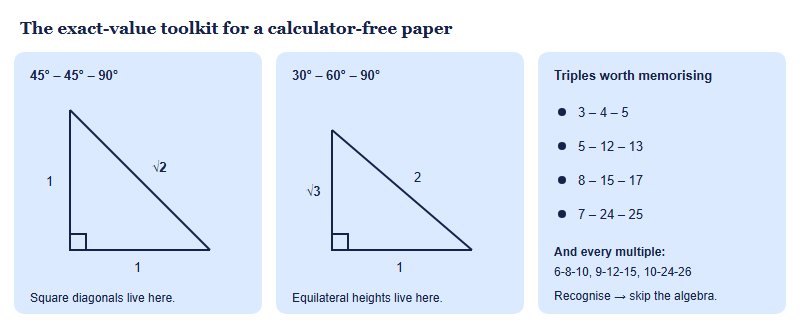
- Recognise, do not compute. If you recognise 9-12-15 as a scaled 3-4-5, you never square anything. If you do not, you square two numbers, add, and take a root by hand.
That last point is where the toolkit below earns its keep. These are not advanced facts; they are the facts that used to be optional because a calculator absorbed the cost of not knowing them.
What geometry looks like at each grade band
Math League has run contests since 1977 and covers grades 4 to 12, so the same word — geometry — describes quite different work depending on where you enter. If you are still choosing an entry point, start with our overview of Math League and the grade-band guide.
- Grades 4-5. Math League lists shapes and perimeter among the published topics for this band, so expect straightforward figure work rather than formal geometry; confirm the current list on mathleague.com. The skill being tested is careful reading and unit consistency far more than geometric insight.
- Grades 6-8. Math League’s published list for this band includes angle measurement, perimeter, area, circumference, basic roots, and triangles and right triangles; confirm the current list on mathleague.com. This is the band where the drawing habit either forms or does not.
- Grades 9-12. Math League lists geometry and coordinate geometry alongside algebra, trigonometry, logarithms, sequences and probability among the topics its high school problems draw from. Geometry here often arrives fused with something else — a coordinate set-up that needs a distance formula, or a triangle that needs a trigonometric ratio.
Note also the structural point from the high school series: there are six high school contests each year with six questions each and a 30-minute limit per contest, and the last two questions are described as generally harder than the first four. Six questions in half an hour means roughly five minutes each — enough time to draw properly, and not enough time to draw twice.
A four-week geometry block that actually changes scores
Geometry responds unusually well to concentrated work, because most of the gain comes from pattern recognition rather than accumulated technique. A block of four focused weeks alongside your normal schoolwork is a reasonable unit; for how this fits a full season, see the study roadmap.
- Week 1 — drawing only. Take twenty worded geometry questions and, for each, produce only a labelled figure. Do not solve. The goal is to make the sentence-to-figure conversion automatic and fast.
- Week 2 — the exact-value toolkit. Drill the two special triangles and four triple families until recognition is instant, and practise finishing answers in the form a√b or kπ without ever reaching for a decimal.
- Week 3 — configurations. Work through the table above one row at a time. For each configuration, do five questions and write one sentence naming what you looked for first.
- Week 4 — timed mixed sets. Now combine, under contest timing. Track two numbers only: how many you got wrong because of the figure, and how many because of the arithmetic. Those two counts tell you where week five should go.
That final tracking step is the part most students skip and the part that makes the block repeatable. A geometry error log split into figure errors and computation errors is more useful than a general score, because the two require completely different remedies.
Frequently asked questions
Do Math League geometry questions come with a diagram?
Often not — many are given entirely in words, so drawing and labelling the figure yourself is part of the task. Formats vary by contest.
Can I still use a calculator on geometry questions?
No. Math League states on mathleague.com that from September 2026 calculators are not permitted on any of its contests. Confirm current rules on mathleague.com.
Should answers be left as surds and π, or as decimals?
Work in exact form. Papers are marked against a solution key, so match the form the question asks for and avoid unnecessary rounding.
How much geometry is on the high school contests?
Math League lists geometry and coordinate geometry among the topics its high school problems draw from, alongside algebra, trigonometry and probability.
This is an independent guide operated by Hanlin Education for China-based international-school students. We are not affiliated with, endorsed by, or sponsored by the official Math League (mathleague.com). Contest dates, eligibility, formats and rules change — always confirm current details on mathleague.com before entering. Any factual error reported to our editorial desk is corrected within 7 working days.