Math League covers grades 4 through 12, which makes it unusually useful as the spine of a multi-year plan rather than a single event on a CV. The sensible pattern is one continuous annual contest that tracks growth, plus at most one higher-ceiling contest added at the right moment. Everything below is about sequencing — what to add, when, and what to refuse.
Spine and branches: why continuity beats collecting
Chinese international-school families tend to plan competitions as a shopping list: which contests are worth doing this year. That produces a scattered record — three contests in grade 8, none in grade 9, five in grade 11 — from which nobody, including the student, can tell whether anything improved.
A spine-and-branch plan works differently. The spine is one contest sat every single year, in the same family, so that scores are comparable over time. Math League fits that role well for a mechanical reason: it has been running since 1977, when it was formed by Steven R. Conrad and Daniel Flegler, and it maintains separate contests for grade 4, grade 5, grade 6, grade 7 and grade 8, an Algebra 1 contest, and a high-school series of six contests across the season. A student can therefore stay inside one system while the difficulty rises with them.
- Contest registration
- Free past papers
- 1-on-1 trial lesson

“Comparable” is doing real work in that sentence. A score only carries information when you know what it is being compared with — the same student, on the same contest family, one year earlier. Certificates from five different organisations tell you that a family was busy. A five-year line from one contest family tells you whether a student is improving faster than the paper is getting harder, which is the only question that actually matters when deciding what to do next year.
The branches are the high-ceiling contests you add for one or two seasons when a student is genuinely ready. Branches are optional. The spine is not, because the spine is what makes the branches interpretable.
Before mapping years, confirm the basics: our guide to what Math League is covers the structure, and the grade-band guide covers which contest a student should actually sit this year.
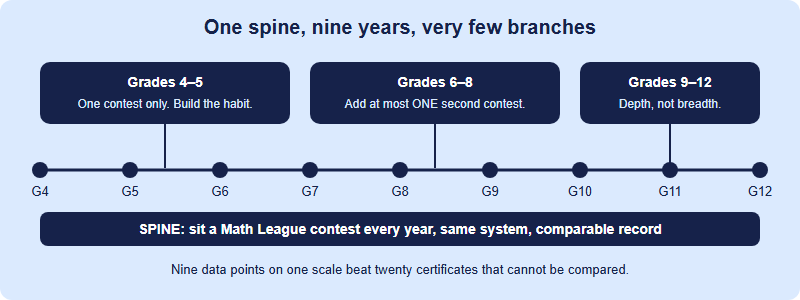
The stage map
| Stage | What the spine gives you | What to add | What to refuse |
|---|---|---|---|
| Grades 4–5 | First experience of a timed English-language maths paper; a baseline you will still be referring to in grade 9. | Nothing. One contest a year is the whole plan. | Any contest chosen because a classmate is doing it. Any coaching that starts before a first sit. |
| Grades 6–8 | A three-year band where the same contest family lets you watch a real trend line, not noise. | At most one higher-ceiling contest, and only after two stable Math League seasons. | Adding a second contest in the same term as a band change. Two new things at once teaches you nothing about either. |
| Grades 9–10 | Entry to the high-school series, which runs as six contests across a season rather than a single sitting. | Depth: consistency across the series, plus one branch contest if grade 8 was strong. | Dropping the spine because a branch looks more prestigious. The spine is your continuity evidence. |
| Grades 11–12 | A closing record with several comparable years behind it. | Nothing new. Finish what you started; add school-level roles such as coaching juniors. | Starting a brand-new contest in grade 12. Late entries with no history read as decoration. |
The most common planning failure sits between grades 8 and 9. A family finishes the middle-school band, the student moves into a demanding first year of an international curriculum, everyone agrees to “take a year off contests”, and the spine breaks. Two years later there is a gap in the middle of the record precisely where the student was becoming interesting. If a year genuinely has to be lighter, keep the sitting and cut the preparation — an unprepared sit still produces a comparable data point, whereas a skipped year produces nothing.
One planning detail worth knowing early: Math League also runs summer programmes, including an International Summer Tournament for grades 4 to 10 and an International Summer Challenge advertised for grades 3 to 12 in seven levels — the 2026 Challenge is listed on mathleague.com as Sunday, 16 August 2026, from 12 to 2 PM Eastern Time. Access differs by programme: mathleague.com sets qualifying routes for the Tournament (including a score of 25 or higher on its grade 4 to 8 contests, and it will also consider students who have not sat its contests), while the Challenge is advertised as open to all interested students for a fee. That is a useful structural fact for planners: the school-year contest is one recognised route into the Tournament, so a missed year can narrow the options — confirm current criteria on mathleague.com. Confirm current dates and criteria on mathleague.com before building anything around them.
The load rule: how much is too much
Overload rarely announces itself as “too many contests”. It shows up as declining scores on the contest the student used to be good at, and as practice that quietly stops happening.
Use a simple test. Add up the weekly hours the plan actually requires — school maths homework, spine practice, branch practice — and check what got displaced. If the answer is sleep, exercise or unstructured time, the plan is not ambitious, it is fragile.
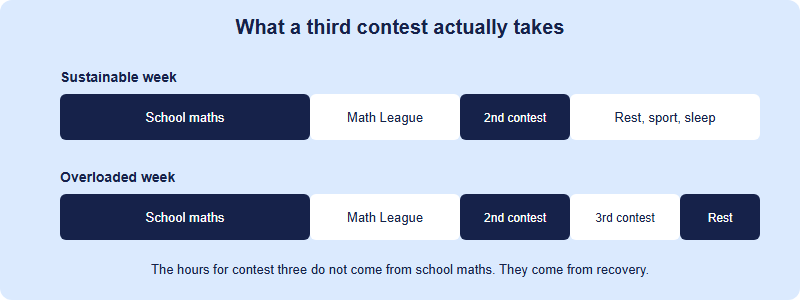
Three load rules that hold up across bands:
- One new thing per year. A new contest, a new band, or a new format — never two in the same season.
- Add only after two stable seasons on the spine. If Math League scores still swing widely year to year, a second contest will not fix that; it will hide it.
- Protect the term with school exams. International-school calendars have their own peaks. A contest that lands in the same fortnight as internal assessments will lose, and the loss will be blamed on the student rather than the scheduling.
There is one early-warning signal worth watching for, because it precedes visible score decline by months: the student stops doing the review and only does the papers. Review is the part that requires attention rather than momentum, so it is the first thing a tired student drops — and because scores hold up for a while on existing knowledge, nobody notices until a season has been wasted. If the error log stops being filled in, treat that as the overload alarm, not as laziness.
The three transitions that break plans
Transition 1: the band change. Moving from a grade 4 or grade 5 contest into the middle-school contests is not a small step up; confirm on mathleague.com which contest applies to each grade before comparing scores. Expect a score dip in the first year of a new band and plan for it, or you will misread a normal transition as decline.
Transition 2: entering the high-school series. The high-school programme runs as six contests across a season rather than one sitting. That rewards consistency and punishes a single bad morning much less — but it also demands sustained preparation across months rather than a sprint. Students who prepared for one-shot contests often under-plan their first high-school season. Confirm the current structure and dates on mathleague.com.
Transition 3: the September 2026 no-calculator change. Math League states that from September 2026 calculators are no longer allowed on any of its contests. For a student who has spent two or three seasons with one, the first no-calculator season is effectively a format change, and arithmetic fluency needs to be scheduled deliberately rather than assumed. Our study roadmap shows where that fits into a weekly routine.
The annual ledger: one page per year
The reason multi-year plans fail is not ambition; it is that nobody records anything, so every August the family re-decides from scratch. Keep one page per year with these columns, and the next decision becomes obvious rather than emotional.
| Field | Grade 6 example | Why it earns its place |
|---|---|---|
| Contest and band sat | Math League, grades 6–8 band, first year in band | Prevents comparing scores across different papers. |
| Raw score | Recorded as sat, not rounded or reinterpreted | The only honest trend line you will have. |
| Dominant error bucket | Arithmetic slips, then misreading | Points to next year’s training, not next year’s shopping. |
| Hours per week actually spent | About 2, mostly the fortnight before | Distinguishes “not able” from “not prepared”. |
| Decision for next year | Same band, no second contest, fix arithmetic | Written in June, not argued about in September. |
Five fields, once a year, nine years. By grade 11 a student has something genuinely rare: evidence of a decision process, not just a pile of results.
Honest limits
Two cautions, because multi-year planning attracts inflated promises. First, no contest record — Math League or any other — guarantees an admissions outcome anywhere. What a long, consistent record can do is support a claim of sustained interest that a single certificate cannot. Second, the plan above deliberately does not tell you which second contest to add; that depends on the student’s ceiling, school offer and calendar, and any adviser who answers that question without seeing three years of scores is guessing.
A third caution concerns the student rather than the record. A multi-year plan is only sustainable if the student can eventually explain why they are doing it in their own words. Somewhere around grade 9 or 10, the answer should stop being “my parents arranged it” and become something specific — a kind of problem they like, a topic they want to get good at, a team they want to be picked for. If that shift never happens, the ledger will keep filling in but the scores will flatten, and no amount of additional contests will restart them.
The defensible version of the strategy is unglamorous: sit one contest every year, record five fields, fix the top error bucket, and add a branch only when the spine is stable. Most students who look impressive at grade 12 did exactly that, starting somewhere around grade 6, without a dramatic year at any point.
Frequently asked questions
Is it a problem if we start Math League in grade 8 rather than grade 4?
No. A shorter honest record still works. Start now, keep the ledger, and let the trend build from this year.
Should a strong grade-7 student sit a higher band for a challenge?
Usually no. Sitting your own band keeps scores comparable year to year, which is the whole value of a spine.
How many maths contests per year is reasonable?
One spine contest, plus at most one branch once the spine is stable. Three or more in a season almost always costs rest.
Where do we check dates, bands and summer eligibility?
On mathleague.com. Programme dates, contest structure and qualifying criteria are set by the organiser and change between seasons.
This is an independent guide operated by Hanlin Education for China-based international-school students. We are not affiliated with, endorsed by, or sponsored by the official Math League (mathleague.com). Contest structure, grade bands, dates and summer-programme eligibility are set by the organiser and can change — confirm current details on mathleague.com. No contest result guarantees any admissions outcome. Errors reported to us are corrected within 7 working days.